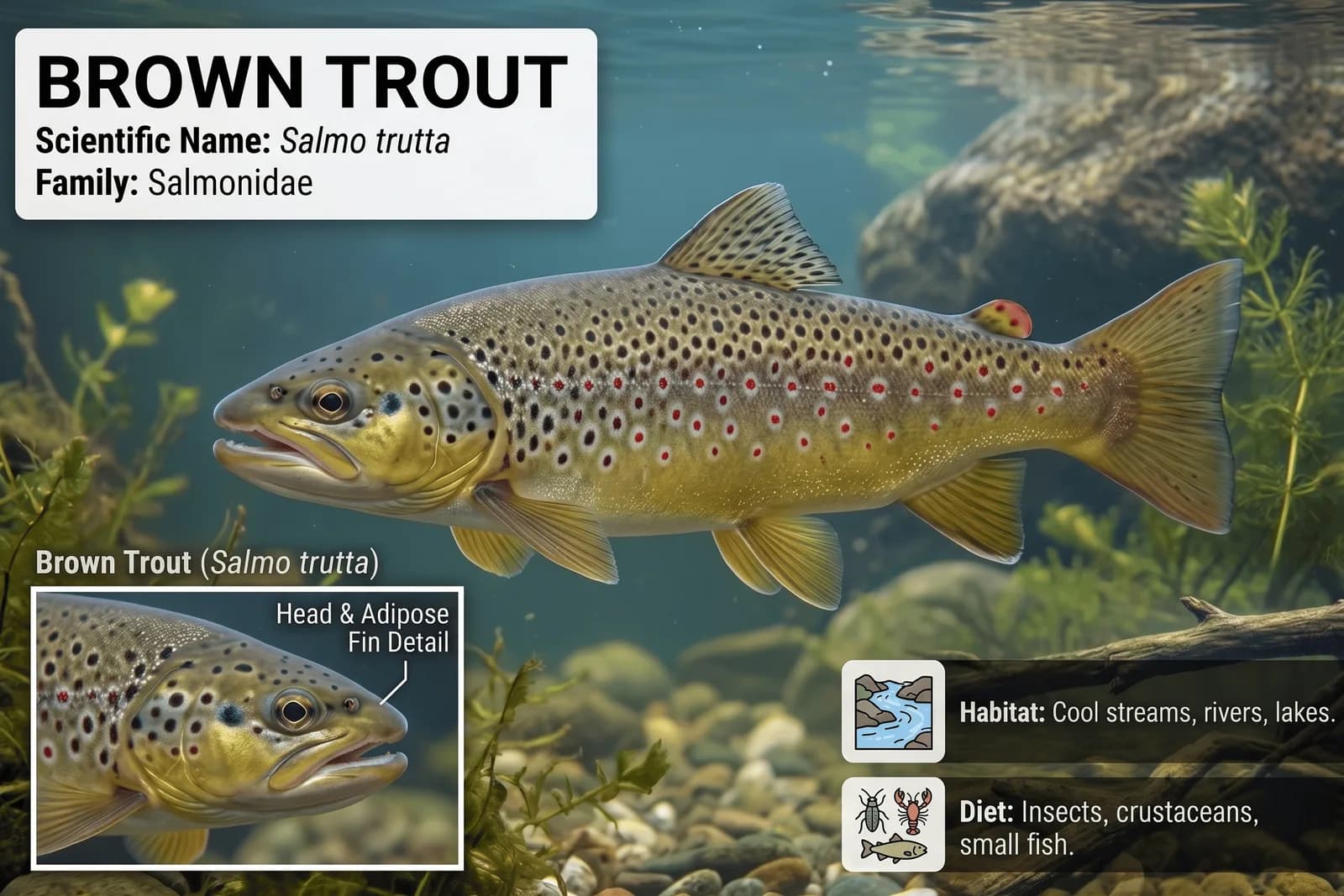
Brown Trout
Salmo trutta · Salmonidae
Also known as: German brown, Loch Leven trout, Sea trout (anadromous form)
An autumn-spawning salmonid, wary and structure-oriented, and the species most likely to produce a genuinely large stream trout in North America.
- Typical size
- 0.3–2 kg (1–4 lb), 25–50 cm
- Max size
- Trophy river fish exceed 4.5 kg (10 lb); lake and sea-run fish grow far larger.
- Water
- Freshwater
- Best season
- Spring and autumn; low light (dawn/dusk) year-round.
Identification
Golden-brown flanks with dark spots plus distinctive red or orange spots ringed by pale halos; squared tail with few or no spots.
Habitat & Range
Cool rivers and streams with gravel bottoms and overhead cover; also lake-run populations that ascend tributaries in fall.
Native to Europe, North Africa and western Asia; widely introduced across the Americas, New Zealand, Australia and beyond.
Diet & Feeding
Aquatic insects and larvae when young; larger fish turn piscivorous, taking baitfish, crayfish, and even mice and small birds.
Spawning & Reproduction
Autumn spawner. Mature fish run gravel-bottomed tributaries as water cools and cut redds; unlike Pacific salmon, browns survive to spawn again.
Spawning windowSource-verified
- Run begins
- Oct 15
- Peak
- Nov 5
- Ends
- Nov 30
- Redd temperature
- 42–48°F
The run and the spawn are distinct events, often 4-6 weeks apart. Migration into tributaries begins Sept-Oct; redd construction requires 42-48F. Browns survive spawning and repeat in later seasons.
Timing is modelled for a mid-latitude reference population — fish the thermometer, not the calendar. Based on 3 cited sources.
Spawning timing by location
Spawning tracks water temperature, so the calendar shifts with latitude and elevation. These break brown trout timing down by state and water body.
- When Do Brown Trout Spawn in Utah?
Utah brown trout peak in November — later than most of the Rockies. Elevation spreads the state's timing by weeks, and the Green River tailwater below Flaming Gorge runs on a schedule of its own.
- When Do Brown Trout Spawn in Wisconsin?
Wisconsin brown trout spawn from late October into November, triggered at 42–48°F. The complication is legal, not biological: inland trout season closes on 15 October, before the peak.
- When Do Brown Trout Spawn in Colorado?
Colorado brown trout peak in October, earlier than almost anywhere else in the country. Elevation is the reason — and it splits the state's timing by nearly a month.
- When Do Brown Trout Spawn in Michigan?
Michigan's brown trout run starts in September, but the actual spawn doesn't happen until water drops to 42–48°F — usually late October through November. Here's the difference, and why it matters.
- When Do Brown Trout Spawn in Montana?
Montana brown trout spawn from October into December, triggered at 42–48°F. But timing is only half of what you need — parts of the Big Hole and Beaverhead close entirely during the spawn.
How to Catch
Browns are wary and cover-oriented — approach quietly, keep low, and fish undercut banks, logjams, and seams. The biggest feed hardest at dusk and after dark.
Best techniques
- Fly fishing (dry fly, nymph, streamer)
- Spinning
- Light-line drifting
Lures & baits
- Mayfly & caddis imitations
- Streamers
- Spinners
- Worms
Best season: Spring and autumn; low light (dawn/dusk) year-round.