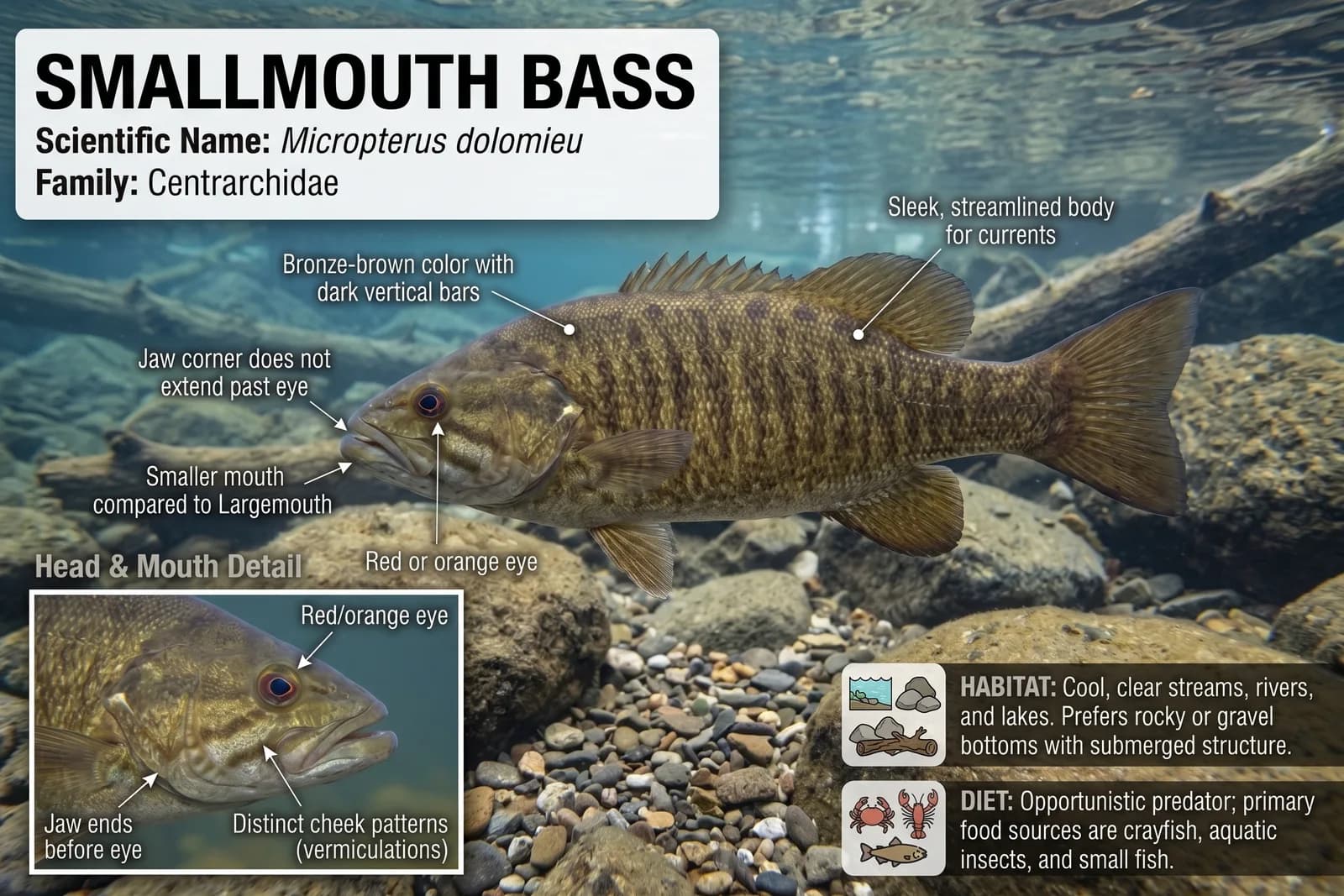
Smallmouth Bass
Micropterus dolomieu · Centrarchidae
Also known as: Bronzeback, Smallie, Brown bass
Pound for pound one of the hardest-fighting freshwater gamefish.
- Typical size
- 0.3–1.5 kg (0.7–3 lb)
- Max size
- Trophy fish exceed 2.7 kg (6 lb).
- Water
- Freshwater
- Best season
- Late spring and fall; current seams in rivers all season.
Identification
Bronze to brown with vertical bars; the upper jaw stops at the eye, and the eye often has a red tint.
Habitat & Range
Clear, cooler lakes and rivers with rock, gravel, and current — the opposite of largemouth's weedy cover.
Native to the central and eastern US and southeastern Canada; widely introduced.
Diet & Feeding
Crayfish are the staple, plus baitfish and insects.
Spawning & Reproduction
Spring, on gravel or rock nests fanned and guarded by the male.
Spawning windowSource-verified
- Run begins
- Apr 10
- Peak
- May 15
- Ends
- Jul 1
- Redd temperature
- 60–64°F
Wisconsin DNR gives 62-64F as typical, but records fish spawning as low as 53F; Missouri's MDC has spawning starting once water exceeds 60F, from early or mid-April well into June or July, peaking in May. The male sweeps a saucer-shaped nest with his tail fin, about twice his own length across, floored with coarse gravel and rock - and builds several practice nests before settling. Site selection is the giveaway: quiet water near shore, or downstream of a boulder or other obstruction that breaks the current, where there is no perceptible current but cover or deep water is close. Nests hold about 2,500 eggs on average and sometimes 10,000; they hatch in 2 or 3 days, the fry stay at the nest about 12 more days, and the male guards nest and fry until they disperse.
Timing is modelled for a mid-latitude reference population — fish the thermometer, not the calendar. Based on 2 cited sources.
Spawning timing by location
Spawning tracks water temperature, so the calendar shifts with latitude and elevation. These break smallmouth bass timing down by state and water body.
- Smallmouth vs Largemouth Bass: How to Tell Them Apart
Colour is the first thing people reach for and the least reliable thing there is — a smallmouth from clear rock and a largemouth from a tannic pond can look like the same fish. The jaw settles it, two state agencies word it identically, and it works on a fish you have never seen before.
How to Catch
Fish rock — points, ledges, and current breaks. Smallmouth pull hard and jump, so keep steady pressure.
Best techniques
- Drop-shot & Ned rig
- Tube jigs
- Topwater
- Crankbaits
Lures & baits
- Crayfish imitations
- Soft plastics
- Live crayfish & minnows
- Jerkbaits
Best season: Late spring and fall; current seams in rivers all season.