Buyer's Guide
Top 5 Fluorocarbon Leader Lines
Fluorocarbon is a leader material first and a main line second, and understanding why makes the whole category simple.
It has three properties nylon does not. Its refractive index sits much closer to that of water, so it is harder for a fish to see. It is denser than water, so it sinks rather than hanging in the surface film. And it is harder on the outside, so it survives contact with shell, rock and a fish's teeth better than nylon of the same diameter.
Those are exactly the properties you want in the last few feet of a setup and not necessarily in the other two hundred yards, which is why the standard modern rig is braid on the spool and a fluorocarbon leader on the end. The five below cover leader material, main line fluoro, and the budget end.
ChronicAnglers is reader-supported. When you buy through links on our site, we may earn an affiliate commission at no extra cost to you.
At a glance
| # | Leader | Best for | Type |
|---|---|---|---|
| 1 | Seaguar Blue Label Fluorocarbon Leader | Best overall leader | 100% fluorocarbon leader |
| 2 | Seaguar Red Label Fluorocarbon | Best fluorocarbon main line | 100% fluorocarbon |
| 3 | Berkley Vanish Fluorocarbon | Best value | Fluorocarbon |
| 4 | Yo-Zuri HD Fluorocarbon Leader | Best for abrasive ground | Fluorocarbon leader |
| 5 | KastKing FluoroKote Fishing Line | Best budget | Fluorocarbon-coated copolymer |
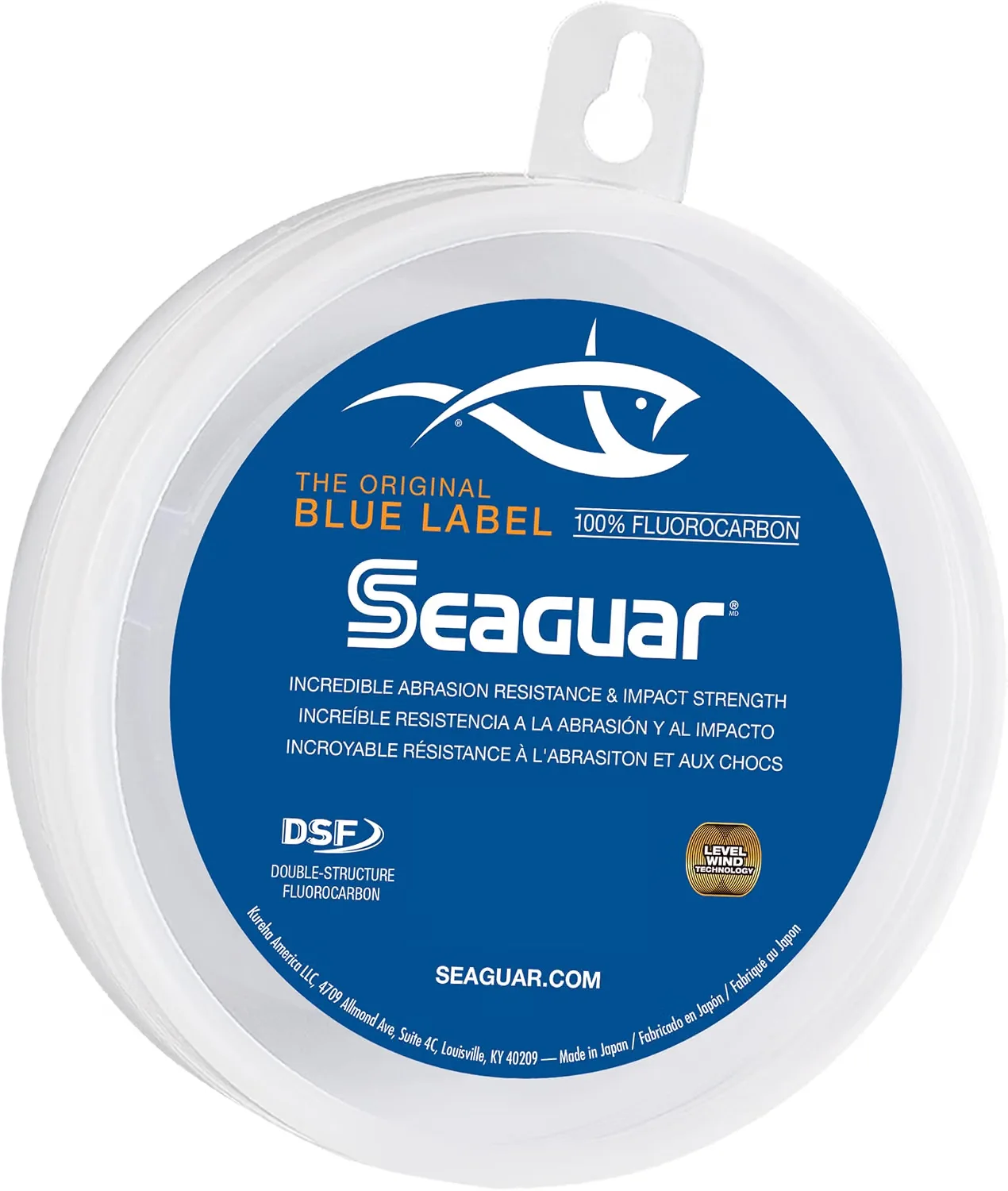
Seaguar Blue Label Fluorocarbon Leader
- Use:
- Leader material
- Spools:
- Short leader spools
- Best for:
- Inshore salt, clear water
Blue Label is the leader material other leader materials get compared to, and it is sold the way leader material should be sold: on short spools in the heavier tests you actually tie leaders in, rather than on 300-yard filler spools. It is a stiff, dense, hard-surfaced fluorocarbon, which is precisely what you want in the last three feet, because stiffness helps a leader stand off the knot and turn a lure over, density gets it down, and the hard surface takes the punishment from oyster, jetty rock and a fish's jaw. It is not cheap, but a leader spool goes a very long way when you are only ever using a rod length at a time, and this is the section of the setup where the fish makes its decision.
- The benchmark leader material for clear-water fishing
- Sold in leader-length spools and useful heavier tests
- Hard surface stands up to shell, rock and teeth
- Stiff enough to turn a lure over on the cast
- Expensive per yard compared with mono leader
- Too stiff to be a comfortable main line
- Unforgiving of a knot seated dry
Seaguar Red Label Fluorocarbon
- Use:
- Main line
- Spools:
- Filler spools
- Best for:
- Bass, clear lakes
Red Label is the one to reach for when you want fluorocarbon on the reel rather than just on the end, which is a real preference among bass anglers fishing clear water with baitcasters. Full fluoro main line gives you the low visibility everywhere, the sinking behaviour that helps a crankbait run a little deeper and keeps a slack line out of the surface film, and the abrasion resistance right through the cast. It is sold on filler spools at a price that makes that realistic. The catch is the usual one with fluorocarbon main line, which is memory: it is stiffer than nylon and it likes a baitcaster far more than a small spinning reel.
- Full fluorocarbon on filler spools at a sensible price
- Low visibility along the whole line, not just the leader
- Sinks, which helps crankbaits and slack-line presentations
- Well suited to baitcasting gear
- Memory makes it awkward on small spinning reels
- Stiffer and less forgiving to knot than mono
- Costs more than monofilament main line
Berkley Vanish Fluorocarbon
- Character:
- Softer, manageable
- Use:
- Main line or leader
- Best for:
- General freshwater
Vanish is the fluorocarbon most people meet first, because it is on the shelf in general sporting goods stores at a price close to premium monofilament. It is softer and more manageable than the stiffer premium fluoros, which makes it easier to live with on a spinning reel and easier to knot, at the cost of some of the abrasion resistance and stiffness that make fluorocarbon distinctive in the first place. That is a reasonable trade for general freshwater work where you want the low visibility without rebuilding your whole setup, and it is a sensible first fluorocarbon before deciding whether you want to spend more.
- Widely available at a price close to premium mono
- Softer and easier to handle than stiff premium fluoro
- Works as either a light main line or a leader
- A reasonable first fluorocarbon
- Less abrasion-resistant than premium fluorocarbon
- Softness costs some of the stiffness a leader wants
- Not the choice for heavy structure or toothy fish
Yo-Zuri HD Fluorocarbon Leader
- Use:
- Leader material
- Character:
- Hard, abrasion focused
- Best for:
- Snook, redfish, structure
Yo-Zuri's HD leader is built around the property that matters when the fish or the ground is trying to cut you off, which is surface hardness. This is the leader to tie when you are fishing snook around dock pilings, working oyster bars for redfish, or dealing with fish that have teeth but not enough teeth to require wire. It is stiff, which is the point, and stiff leader also does the useful secondary job of keeping a soft plastic from fouling on the leader during the cast. If your leaders come back scuffed and chalky after every fish, this is the direction to move in, and it is worth having a spool of it alongside a softer leader for clear, calm days.
- Built specifically around abrasion resistance
- Stiff enough to resist fouling on the cast
- Good choice around pilings, oyster and rock
- Sold in leader-appropriate spools and tests
- Stiffness makes knots fussier to seat
- Overkill in clear, open, snag-free water
- Not a main line
KastKing FluoroKote Fishing Line
- Construction:
- Copolymer core, fluoro coating
- Use:
- Main line
- Best for:
- Budget setups
This one needs its category read carefully, because it is a fluorocarbon-coated copolymer rather than 100 percent fluorocarbon, and that is a description rather than a criticism. A coated line behaves more like nylon: softer, less memory, easier on a spinning reel, cheaper per yard, and it keeps some of the surface properties of fluorocarbon where the line meets the water. What it does not have is the density and through-and-through hardness of solid fluorocarbon, so it does not sink the same way and it will not take the same abuse. As a budget main line for someone who wants better manners than stiff fluoro, it makes sense. As a leader for a hard-fighting fish around structure, it does not.
- Much cheaper than 100 percent fluorocarbon
- Softer and easier to manage than solid fluoro
- Behaves well on spinning reels
- Keeps some fluorocarbon surface properties
- Coated copolymer, not 100 percent fluorocarbon
- Does not sink like solid fluorocarbon
- Not the leader for structure or toothy fish
How to choose a fluorocarbon
- Leader spools and filler spools are different products: leader material comes on short spools in heavier tests and is stiffer on purpose, while filler spools are softer and meant for the reel. Buying the wrong one is the most common mistake in this category.
- Read the label for 100 percent: several popular lines are fluorocarbon-coated copolymer rather than solid fluorocarbon. Coated line is softer and cheaper and behaves more like nylon, which is fine as long as you know that is what you bought.
- Fluorocarbon sinks, and that changes presentations: it pulls a topwater lure's nose down and helps a crankbait or a slack-line soft plastic get where you want it. Use mono for topwater and fluoro for almost everything under the surface.
- Wet every knot before you seat it: fluorocarbon is hard and generates more friction heat than nylon, and a dry-seated knot is the classic reason a fluoro leader breaks at the knot for no apparent reason.
- A rod length of leader is the usual starting point: long enough that the braid stays away from the fish, short enough that the connection knot stays outside the guides on the cast.
Frequently asked questions
- Why use a fluorocarbon leader with braid?
- Braid has two weaknesses: it is highly visible and it has poor abrasion resistance. Fluorocarbon has the opposite properties, sitting close to water in refractive index and being hard on the surface. A rod length of fluoro leader on the end of braid gives you braid's sensitivity and strength with fluorocarbon's invisibility and toughness where it counts.
- Is fluorocarbon really invisible underwater?
- Not invisible, but considerably less visible than nylon. Its refractive index sits much closer to that of water, so it bends light less. In clear water on pressured fish that difference is real; in stained water or heavy current it matters much less, and mono leader is perfectly adequate.
- What is the difference between fluorocarbon leader and fluorocarbon main line?
- Leader material is stiffer, sold on short spools in heavier tests, and built for abrasion resistance and knot strength. Main line fluoro is softer and sold on filler spools so it will behave on a reel. Using main line as leader gives you a softer leader than intended, and using leader material as main line gives you memory problems.
- Does fluorocarbon sink?
- Yes. It is denser than water, so it sinks rather than sitting in the surface film. That helps subsurface presentations and hurts topwater ones, which is why many anglers keep monofilament leader for topwater lures and fluorocarbon for everything else.
- Why does my fluorocarbon keep breaking at the knot?
- Almost always because the knot was seated dry. Fluorocarbon is harder than nylon and generates more friction heat as a knot pulls tight, which damages the line at exactly the point under most load. Wet every knot before seating it and pull it tight steadily rather than sharply.
- How heavy should my leader be?
- Heavy enough for the ground you are fishing rather than the fish you expect. Clear open water lets you drop lighter and get more bites; oyster, rock, pilings and toothy fish push you heavier. Many inshore anglers carry two leader spools and choose on the day.
The bottom line
For almost everyone the answer is Seaguar Blue Label as leader material on the end of braid, because that is where fluorocarbon earns its price and a single leader spool lasts a very long time. If you want fluoro on the reel, Red Label is the sensible full-fluorocarbon main line, and Berkley Vanish is the softer, cheaper way to try the category before committing. Whatever you buy, wet the knot before you pull it tight.
ChronicAnglers is reader-supported. When you buy through links on our site, we may earn an affiliate commission at no extra cost to you.