Buyer's Guide
Top 5 Monofilament Fishing Lines
Monofilament gets talked about as the line you use before you know better. That is wrong, and the reason is stretch.
Nylon monofilament stretches substantially under load. For someone learning, that stretch absorbs a violent hook set, a drag screwed down too far and a fish that lunges at the net, which are three of the most common ways beginners lose fish. For experienced anglers it does exactly the same job anywhere a cushion helps, which is why treble-hooked crankbaits are still fished on mono long after the angler has braid on every other reel.
It is also the cheapest of the three line types, and that matters more than it looks. Mono takes a set on the spool and weakens in sunlight, so it needs replacing. A line you will actually respool beats a premium line left on for three seasons.
ChronicAnglers is reader-supported. When you buy through links on our site, we may earn an affiliate commission at no extra cost to you.
At a glance
| # | Line | Best for | Type |
|---|---|---|---|
| 1 | Berkley Trilene XL Monofilament | Best overall | Monofilament |
| 2 | Berkley Trilene Big Game | Best for big fish and abrasion | Monofilament |
| 3 | Maxima Ultragreen Monofilament | Best for rivers and clear water | Monofilament |
| 4 | Stren Original Monofilament | Best classic all-rounder | Monofilament |
| 5 | KastKing World's Premium Monofilament | Best budget | Monofilament |
Berkley Trilene XL Monofilament
- Character:
- Extra limp
- Best for:
- Spinning reels, crankbaits
- Range:
- Very wide
Trilene XL has been the default answer to what mono should I buy for a very long time, and the XL is the reason: it stands for extra limp, and limpness is what you want on a spinning reel. A limp line comes off the spool in loose coils rather than springs, which means fewer tangles, less memory and better casting, especially with light lures. It is not the toughest mono in this list and it is not trying to be. It is the balanced, forgiving, everyday line that suits the majority of freshwater fishing, it knots easily, and it is stocked in every shop that sells line at all.
- Limp enough to behave properly on a spinning reel
- Manageable memory for a nylon line
- Available in every pound test and spool size
- Inexpensive enough to respool without thinking about it
- Less abrasion-resistant than the heavy-duty monos
- Stretches, which is a feature until you want direct contact
- Degrades in sunlight like all nylon
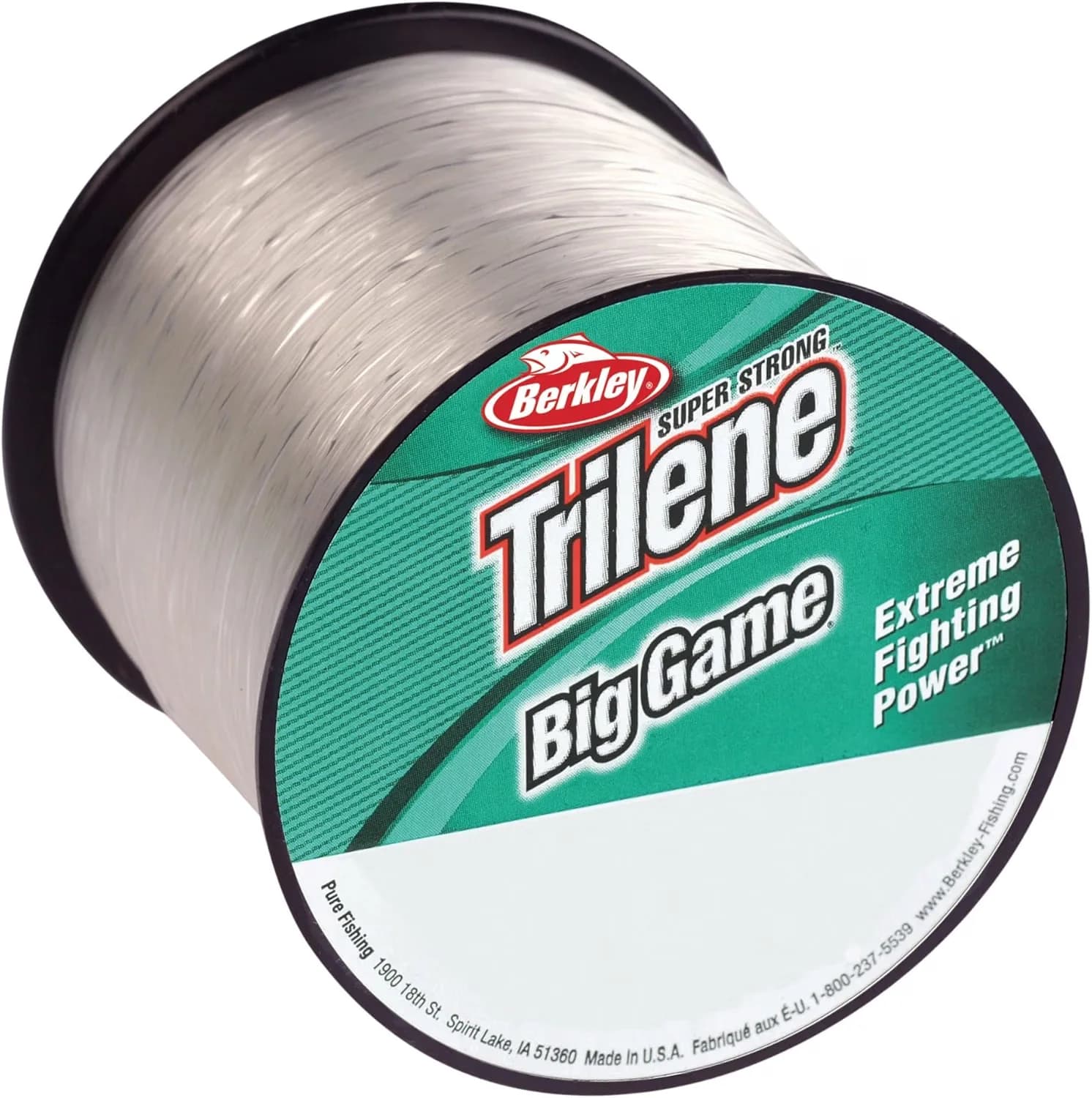
Berkley Trilene Big Game
- Character:
- Stiff, abrasion resistant
- Best for:
- Surf, catfish, leaders
- Spools:
- Bulk
Big Game sits at the opposite end of the monofilament range from XL: stiffer, tougher, and sold in large bulk spools because the people who buy it use a lot of it. This is the line for surf fishing, for catfish, and for anywhere the line is going to be dragged across sand, rock, shell or a pier piling, which is the situation where a limp line fails first. It is also one of the most widely used cheap leader materials there is, and a bulk spool of it will outlast several seasons of tying leaders. It is not a finesse line, it has real memory, and on a small spinning reel it will fight you. That is the trade you are making.
- Genuinely tough against abrasion
- Bulk spools make it very cheap per yard
- Excellent, inexpensive leader material
- Handles big fish and heavy sinkers without complaint
- Stiffer than XL, with noticeable memory
- Not suited to light finesse presentations
- Large spools are awkward without a spooling station
Maxima Ultragreen Monofilament
- Colour:
- Ultragreen
- Character:
- Abrasion resistant
- Best for:
- Trout and salmon rivers
Maxima has a reputation among river anglers that has lasted decades and it rests on two things: it is tougher against rock than most monofilament, and the green tint genuinely disappears in the kind of water trout and salmon live in. It is also lower in stretch than a typical soft mono, which helps when you are setting a hook at distance across current. It is stiffer than a limp spinning line, so it works better as a river main line and as leader material than as a general-purpose spool filler on a small reel, and that is exactly how most people use it. Fly anglers build leader butts from it for the same reason.
- Very good abrasion resistance for a monofilament
- Green tint suits rivers and stained water
- Excellent leader material for fly and spin
- A long-standing reputation among river anglers
- Stiffer than XL, so more memory on small spinning reels
- Green is not the right colour in every water
- Costs more than budget mono
Stren Original Monofilament
- Character:
- Balanced
- Options:
- Low-vis and high-vis
- Best for:
- General fresh and light salt
Stren Original has been on shelves for generations and it sits deliberately in the middle of the range: more abrasion resistance than a very limp line, more manageable than a stiff one. The high-visibility version is the part worth thinking about. A line you can see above the water while the fish cannot see it below is genuinely useful for detecting bites on slack line, which is most of what happens when you are float fishing or fishing bait on the bottom and watching the line rather than feeling it. Pair a high-vis main line with a clear leader and you get both halves of that.
- Balanced between limp and tough
- High-vis versions genuinely help bite detection
- Widely available and inexpensive
- A very long track record
- Master of nothing in particular
- High-vis colours are visible to fish too, so run a leader
- Standard nylon sunlight degradation
KastKing World's Premium Monofilament
- Best for:
- Backup spools, first reels
- Range:
- Wide
- Character:
- Soft
The value option, and value matters more in monofilament than in any other line type, because mono is the line that genuinely needs replacing. It takes a set on the spool and it weakens in sunlight over a season, so the cheapest good-enough line frequently outperforms the premium line you left on too long. That makes this the right choice for backup spools, for a child's first reel, for the rod that lives in the garage, and for anyone who owns more reels than sense. It is not as consistent as the premium lines and it is not a finesse line, but it is honest line at a price that removes every excuse not to respool.
- Very low cost per spool
- Good enough for most general fishing
- Makes frequent respooling realistic
- Wide range of pound tests
- Less consistent than premium monos
- More memory than the limpest lines
- Not a big-fish or finesse line
How to choose a monofilament
- Limp or tough, pick your end of the range: limp lines like Trilene XL suit spinning reels and cast better, tough lines like Big Game resist abrasion and handle bigger fish. Almost every mono sits somewhere on that line and no line is both.
- Mono is the cheapest line to keep fresh, so keep it fresh: nylon takes a set on the spool and weakens with sunlight over a season. A great deal of what people blame on a cheap reel is old line with memory.
- Stretch is a feature with treble hooks: a fish shaking its head against a stiff rod and a stretchless line tears small trebles out. Mono is still the sensible choice for crankbaits and other treble-hooked lures.
- Pound test is breaking strength, not the size of fish you can land: your drag, the rod and the angle all take load off the line. A badly tied knot lowers your real breaking strength far more than the rating does.
- High-vis main line plus a clear leader is a real system: you watch the line, the fish sees the leader. It is the cheapest bite indicator there is.
Frequently asked questions
- Is monofilament good for beginners?
- It is the best line for a beginner, and the reason is stretch. Mono absorbs an over-enthusiastic hook set, a drag set too tight and a fish that lunges at the net, which are the three most common ways new anglers lose fish. It also knots easily and costs little enough that respooling is not a decision.
- How often should you replace monofilament?
- At least once a season for a reel in regular use, and more often if the reel lives in the sun. Nylon weakens with sunlight exposure and takes on memory from sitting on the spool. Line that comes off the reel in springs is costing you casting distance and causing tangles.
- Is monofilament or fluorocarbon better?
- They do different jobs. Fluorocarbon sinks and is harder for a fish to see, which makes it a better leader. Monofilament sits closer to neutral, stretches more usefully, knots more easily and costs far less. The common setup is mono or braid as main line with a fluorocarbon leader.
- What is the difference between limp and stiff monofilament?
- Limp line comes off a spinning spool in loose coils, casts better and tangles less. Stiff line resists abrasion better and holds its shape, which makes it a better leader and better in heavy cover. Trilene XL is the limp end of the range and Big Game and Maxima are the stiff end.
- Can you use monofilament as a leader?
- Yes, and it is common. A tough mono such as Trilene Big Game or Maxima Ultragreen makes a cheap, abrasion-resistant leader. Fluorocarbon is less visible and sinks, so it is preferred in clear water, but mono leader is perfectly sound and considerably cheaper.
- Does monofilament float?
- Nylon is close to neutrally buoyant and mono generally sits at or just under the surface, which is why it suits topwater lures and float fishing. Fluorocarbon is denser and sinks, which is why it suits presentations you want to get down.
The bottom line
For most people the honest answer is Trilene XL for general freshwater and Big Game if you fish surf, catfish or anywhere abrasive, with Maxima Ultragreen as the river specialist that doubles as excellent leader material. Whichever you pick, replace it more often than you think you need to. Mono is the cheapest component in the whole setup and the only one actually connecting you to the fish.
ChronicAnglers is reader-supported. When you buy through links on our site, we may earn an affiliate commission at no extra cost to you.