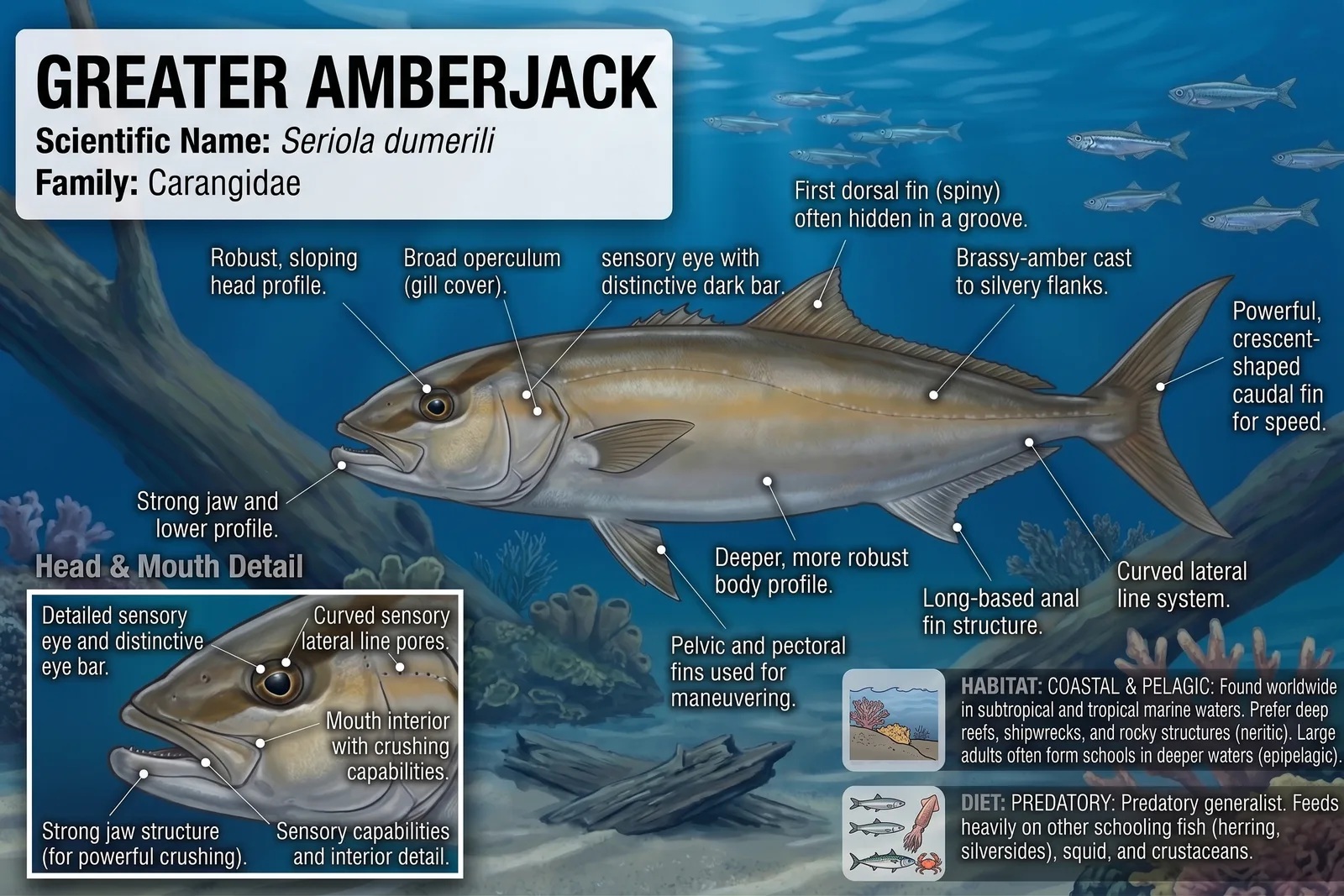
Greater Amberjack
Seriola dumerili · Carangidae
Also known as: AJ, Reef donkey
A powerful reef and wreck predator that fights straight back down into structure. NOAA records them up to 6 feet and 17 years old.
- Typical size
- Adults commonly to about 40 lb
- Max size
- NOAA records up to 6 feet, with some fish reaching 200 pounds. They live up to 17 years.
- Water
- Saltwater
- Best season
- Spring, around the March to June spawning aggregation on reefs and wrecks.
Identification
A dark amber stripe on the head running from the nose to the first dorsal fin, a brownish or bluish-grey back, silvery-white belly, and an amber horizontal stripe along the middle of the body. Juveniles are yellowish with five or six dark vertical bars.
Habitat & Range
Reefs, rocky bottom and shipwrecks, typically at 60 to 240 feet as adults. Juveniles school around floating Sargassum mats.
Atlantic and Pacific Oceans; in the western Atlantic from Nova Scotia to Brazil, including the Gulf and the Caribbean.
Diet & Feeding
Adults take crab, squid and other reef fishes. Juveniles feed on plankton, crustacean larvae and small invertebrates.
Spawning windowSource-verified
- Run begins
- Mar 1
- Ends
- Jun 30
NOAA reports greater amberjack mature at about 3 to 4 years and spawn primarily from March to June on reefs and shipwrecks, with females releasing between 18 and 59 million eggs annually. No agency spawning temperature was found, so none is published.
Timing is modelled for a mid-latitude reference population — fish the thermometer, not the calendar. Based on 1 cited source.
How to Catch
Expect the first run to be straight down into the wreck. Heavy tackle and a locked drag early is the difference between landing one and being cut off. Seasons and bag limits are tightly managed and change, so check NOAA and your state agency before you go.
Best techniques
- Vertical jigging over wrecks
- Live-baiting on structure
- Deep dropping
Lures & baits
- Live blue runners and pinfish
- Heavy metal jigs
- Large soft plastics
Best season: Spring, around the March to June spawning aggregation on reefs and wrecks.