Alaska · United States
Kenai River
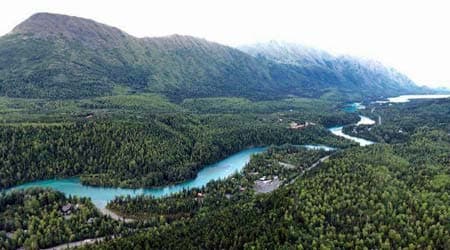
FreshwaterFed by glacial meltwater that gives it a striking turquoise colour, Alaska's Kenai River is legendary for its salmon runs and the outsized rainbow trout that fatten on drifting salmon eggs. Summer brings waves of returning salmon; autumn is prime time for trophy rainbows.
- Water
- Freshwater
- Best time
- Kings Jun–Jul; sockeye Jun–Aug; trophy rainbows Sep–Oct
Target species
- Sockeye salmon
- Rainbow trout
- Coho salmon
- Dolly Varden
- King (Chinook) salmon — closed by emergency order
Recommended techniques
- Drift fishing
- Back-trolling
- Fly fishing
Best time of year: Kings Jun–Jul; sockeye Jun–Aug; trophy rainbows Sep–Oct
Live conditions at Kenai RiverCurrent wind, wave height, water temperature and tide times from the nearest NOAA stations — plus any active weather warnings.The Kenai is the most famous salmon river in North America, and anyone planning a trip right now needs one fact before any of the romance: king salmon fishing on the Kenai was closed for the whole of 2026.
Not restricted. Closed, including catch-and-release.
The king closure, in ADF&G's own words
Alaska Department of Fish and Game issued two emergency orders on 9 February 2026:
- Kenai River Early-Run King Salmon Sport Fishery Is Closed — through 19 June 2026
- Kenai River Late-Run King Salmon Sport Fishery Is Closed (order 2-KS-1-7-26) — 20 June to 15 August 2026
The late-run order's wording: "Fishing for king salmon of any size, including catch-and-release, is closed." And: king salmon caught while fishing for other species "must be released immediately and may not be removed from the water."
The reason is in the order too. It cites the Kenai River Late-Run King Salmon Stock of Concern Management Plan, a 2026 forecast of 12,718 large fish, and notes that "The total run forecast is less than the stock of concern recovery escapement goal range of 14,250-30,000 fish" — which would be the sixth lowest on record.
This matters beyond the Kenai: Upper Cook Inlet salt waters north of Bluff Point were closed to king salmon fishing, catch-and-release included, from 1 May to 15 August 2026 under a separate order, 2-KS-7-5-26.
These orders expired 15 August 2026. They are reported here because they show what the Kenai currently is, not because they are the live rule. Check ADF&G's emergency orders in the week you travel. Checked 18 October 2026.
The real lesson: the Kenai runs on emergency orders
This is the thing to internalise about Alaska, and it is why a printed guide or an old article will get you in trouble here.
The regulation book is a starting position. The emergency order is the rule. ADF&G adjusts in-season, in both directions, based on escapement counts as fish actually arrive.
In the Northern Kenai area in 2026 alone, orders included:
- Kenai River early-run kings — closed
- Kenai River late-run kings — closed
- Russian River and upper Kenai River sockeye bag limits — increased
- Kenai River drainage coho limit — remains at two fish
- Anchor River and Deep Creek — closed to all sport fishing through 15 July
- East Cook Inlet razor clams — remain closed for 2026
Note the third line. Orders are not only restrictions; a strong sockeye return gets you a higher bag limit mid-season. An angler who checks is better off in both directions.
Practical rule: check the orders the week you fly, and again the morning you fish.
What the river actually is
The Kenai runs turquoise — glacial flour suspended in the water, not algae — from Kenai Lake through Skilak Lake and out to Cook Inlet. The colour is the single most recognisable thing about it and it has a practical consequence: visibility is low and variable, so presentations that rely on a fish seeing a small bait from distance work less well than those putting something in its face.
The river is managed in reaches, and the rules change between them. The stretch below Skilak Lake outlet is the one named in the late-run king order; the upper river and the Russian River confluence run on their own rules. Where you stand changes what is legal — this is not a river where one summary covers everything.
Where people fish
- The Russian River confluence — the sockeye fishery, and the origin of the phrase combat fishing. Shoulder to shoulder in July, and productive precisely because of it.
- The middle river, Skilak to Soldotna — drift boat water, rainbow trout and Dolly Varden.
- The lower river — the traditional king water, and the personal-use dip net fishery at the mouth, which is for Alaska residents only.
- Upper Kenai, Kenai Lake to Skilak — clearer, smaller, and the best of the trout fishing.
What is there
| Species | Status on the Kenai |
|---|---|
| Sockeye salmon | The main event. Huge runs, July peak, and the reason most people go. |
| King (Chinook) salmon | Closed by emergency order in 2026. Historically the river's signature fish. |
| Coho salmon | Later in the season. A 2026 order held the drainage limit at two fish. |
| Rainbow trout | Excellent, and often overlooked next to the salmon. |
| Dolly Varden | Widespread, and takes the same presentations as the rainbows. |
The Kenai held the world record Chinook salmon, which is most of why the river is famous — and it is worth being blunt that the fishery which produced that fish is the one now closed. Our world record articles cover the catch itself.
If you are going now, go for sockeye and trout. That is an honest framing of the river in its current state, and it is still a world-class trip.
Tackle and technique
Sockeye are not caught in the ordinary sense — they are largely not feeding on the way up. The standard Kenai technique is a weighted fly or bare hook drifted so it is drawn into an open mouth, which is why gear restrictions here are specific and enforced. The late-run order's restriction was "Only one unbaited, single-hook, artificial lure may be used."
- Single, unbaited hooks when an order requires them — and they frequently do.
- Heavy enough line for fish in heavy current; a sockeye in Kenai flow is a serious fight on light tackle.
- Waders and a belt. The Kenai is cold, fast and glacial. This is not the river to wade deep in.
- For rainbows, standard trout gear — see our spinning reel guide, where the Pflueger President is the sensible freshwater choice, and rainbow trout for the fish itself.
- A rubber-coated net matters more than usual here, because a great deal of what you catch is going back by law.
Before you go
- Buy an Alaska sport fishing licence. Non-residents can buy short-term licences.
- Read the current emergency orders for the Northern Kenai area. This is the step people skip and it is the one that decides what you can fish for.
- Check which reach you will be on. The rules differ between them.
- Plan around sockeye timing, not king timing, until ADF&G says otherwise.
- Expect crowds at the Russian River in July. That is the fishery, not a failure of it.
Sources
- Kenai River Late-Run King Salmon Sport Fishery Is Closed — Alaska Department of Fish and Game, emergency order 2-KS-1-7-26 — released 9 February 2026, expiring 15 August 2026, covering the Kenai River drainage downstream of the outlet of Skilak Lake from 20 June through 15 August 2026; that fishing for king salmon of any size including catch-and-release is closed; that kings caught while fishing for other species must be released immediately and may not be removed from the water; that only one unbaited, single-hook, artificial lure may be used; and the stated reason citing the Kenai River Late-Run King Salmon Stock of Concern Management Plan, a forecast of 12,718 large fish against a stock of concern recovery escapement goal range of 14,250–30,000 fish, which would be the sixth lowest on record.
- King Salmon Restrictions in Cook Inlet Salt Waters — ADF&G, emergency order 2-KS-7-5-26 — that king salmon sport fishing in Upper Cook Inlet salt waters north of Bluff Point was closed from 1 May through 15 August 2026 including catch-and-release, the bag limits either side of that window, and the stated reason of low productivity and forecast runs below the lower end of escapement goals on the Kenai, Anchor and Deshka rivers.
- Emergency Orders and Press Releases, Northern Kenai 2026 — ADF&G — the list of 2026 orders for the area, including the early-run Kenai king closure, the Russian River and upper Kenai sockeye bag limit increase, the Kenai River drainage coho limit remaining at two fish, the Anchor River and Deep Creek closure, and the East Cook Inlet razor clam closure.
Frequently asked questions
- Can you fish for king salmon on the Kenai River?
- Not in 2026. Alaska Department of Fish and Game closed both the early-run and the late-run Kenai River king salmon sport fisheries by emergency order. The late-run order, 2-KS-1-7-26, states that fishing for king salmon of any size, including catch-and-release, is closed from 20 June through 15 August 2026. Kings caught while fishing for other species must be released immediately and may not be removed from the water. Check the current emergency orders before any trip — this one expired 15 August 2026 and the 2027 position may differ.
- Why is Kenai king salmon fishing closed?
- Low returns. ADF&G's late-run order cites the Kenai River Late-Run King Salmon Stock of Concern Management Plan and a 2026 forecast of 12,718 large fish, noting that the total run forecast is less than the stock of concern recovery escapement goal range of 14,250 to 30,000 fish, and that it would be the sixth lowest on record.
- What is an Alaska emergency order and why does it matter?
- It is an in-season regulation change issued by ADF&G, and on the Kenai it is the rule that matters more than the printed book. Emergency orders have both closed the king fishery and, separately in 2026, increased sockeye bag limits on the Russian and upper Kenai rivers. Whatever a guidebook says, check the current orders in the week you travel.
- Can you still fish the Kenai if kings are closed?
- Yes. Sport fishing for other species stays open during the king closures, and the Kenai's sockeye run is the reason most anglers go anyway. The late-run order does restrict gear, stating that only one unbaited, single-hook, artificial lure may be used. Rainbow trout and Dolly Varden fishing continues, and coho come later in the year.
- What is the Kenai River best known for?
- Two things. It held the world-record Chinook salmon, and it produces enormous sockeye runs that draw combat-fishing crowds to the Russian River confluence. Right now the sockeye fishery, not the king fishery, is the reason to go.
- What gear restrictions apply on the Kenai?
- They vary by reach and by emergency order, and single-hook unbaited artificial lure restrictions are common when a king closure is in force. The Kenai is divided into reaches with different rules, so the restriction that applies depends on where on the river you are standing. Check the current ADF&G regulations and orders for your specific reach.
- Do you need a licence to fish the Kenai River?
- Yes, a State of Alaska sport fishing licence, with a king salmon stamp historically required to fish for kings. Non-residents can buy short-term licences. Licences are separate from the emergency orders that govern what is actually open.