Crappie
Pomoxis spp. · Centrarchidae
Also known as: Black crappie, White crappie, Papermouth, Speckled perch, Calico bass
Two species under one name, and the fish whose spawning temperature state agencies disagree about more than any other — published figures span 55°F to 68°F, and they do not all mean the same thing.
- Typical size
- 20–30 cm (8–12 in), 250–500 g
- Max size
- Fish over 2 lb are exceptional in most waters.
- Water
- Freshwater
- Best season
- Spring around the spawn, and again through winter under the ice.
Identification
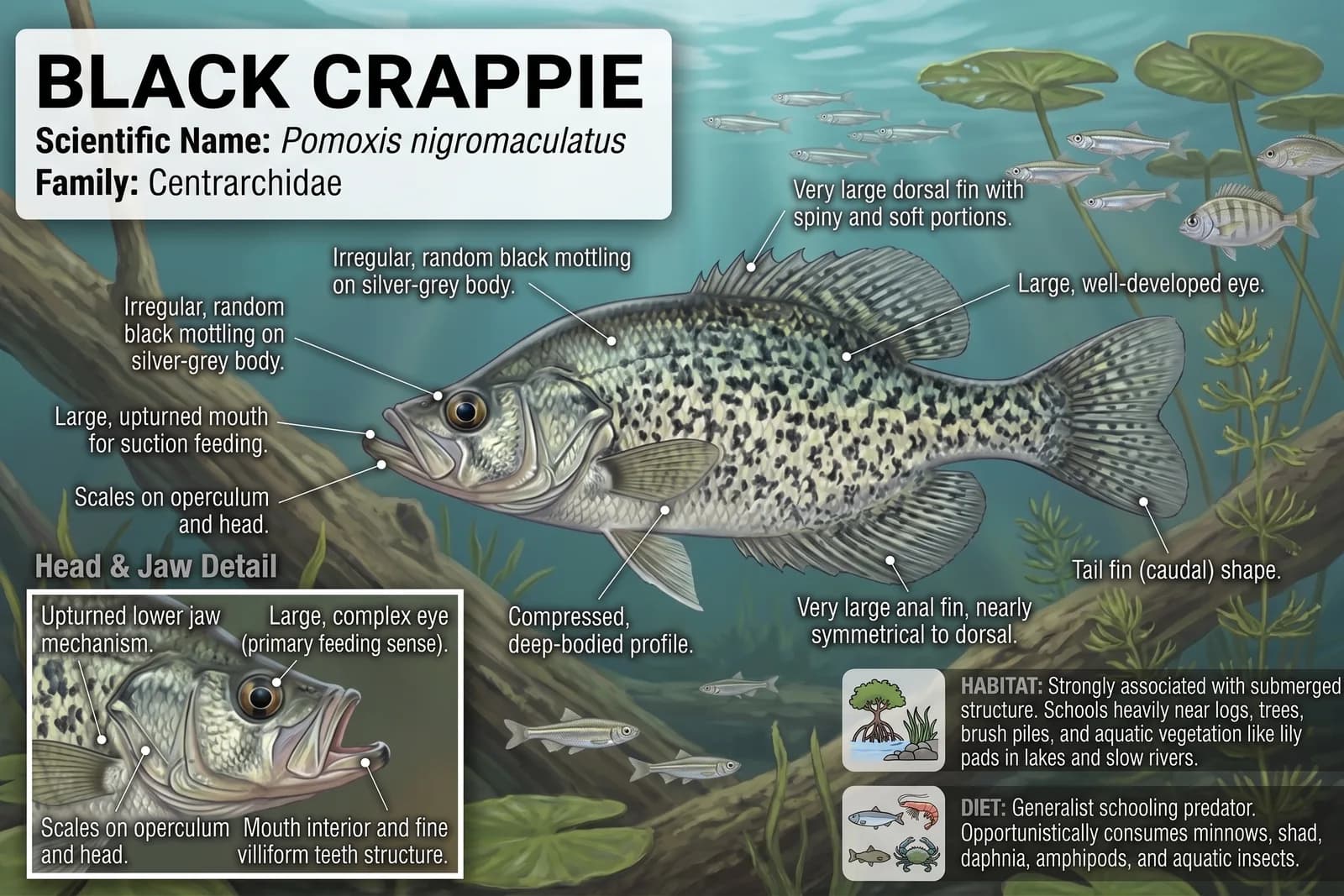
Black crappie carry irregular scattered speckling and seven or eight dorsal spines; white crappie show faint vertical bars and only five or six. Both have the paper-thin mouth membrane that gives them the nickname and costs you fish on a hard hookset.
Habitat & Range
Lakes, reservoirs, ponds and slow river backwaters, tight to brush, standing timber, docks and weed edges. Black crappie prefer clearer water with more vegetation and tolerate silt and murk less well than white crappie.
Native to eastern and central North America and introduced almost everywhere else in the United States.
Diet & Feeding
Zooplankton and insect larvae when small; small fish, especially shad and minnows, as adults. Chiefly a low-light feeder.
Spawning & Reproduction
Males sweep a round nest in sand or fine gravel, often in loose colonies, and guard both the nest and the young until they begin to feed. The depth is set by water clarity rather than the calendar: Missouri's agency records crappie spawning as shallow as one or two feet in stained water and as deep as twenty feet or more in exceptionally clear water.
Spawning windowSource-verified
- Run begins
- Mar 15
- Peak
- May 5
- Ends
- Jun 30
- Redd temperature
- 55–68°F
The range spans genuinely conflicting agency figures rather than one finding. Indiana DNR and Missouri's MDC both give about 55F; Wisconsin DNR gives 64-68F as favourable for black crappie; Minnesota DNR says mid-60s; Tennessee's TWRA separates the species, with white crappie peaking at 60-65F and black at 62-68F. The low figures describe onset and the high ones describe peak, and latitude accounts for much of the rest. MDC gives the season as mid-March in southern Missouri through late May in the north; Wisconsin DNR gives May and June, delayed into July in a cold season.
Timing is modelled for a mid-latitude reference population — fish the thermometer, not the calendar. Based on 3 cited sources.
Spawning timing by location
Spawning tracks water temperature, so the calendar shifts with latitude and elevation. These break crappie timing down by state and water body.
- When Do Crappie Spawn in Michigan?
Michigan crappie spawn from May into June. The number that actually matters isn't the date but the water clarity, which sets how deep the beds are — anywhere from one foot to twenty.
- When Do Crappie Spawn in Ohio?
Ohio crappie spawn in May and June, nesting in one to five feet of water. The temperature question is messier than any page admits: state agencies publish figures from 55°F to 68°F.
How to Catch
Fish light and set soft — the mouth membrane tears, which is why they are called papermouths. Find brush or timber at the right depth for the water clarity and you have found them, because they hold tight to cover and school hard.
Best techniques
- Float fishing
- Vertical jigging
- Spider rigging
- Casting small jigs
- Ice fishing
Lures & baits
- Small minnows
- 1/16 and 1/32 oz jigs
- Soft plastic tubes
- Marabou jigs
Best season: Spring around the spawn, and again through winter under the ice.