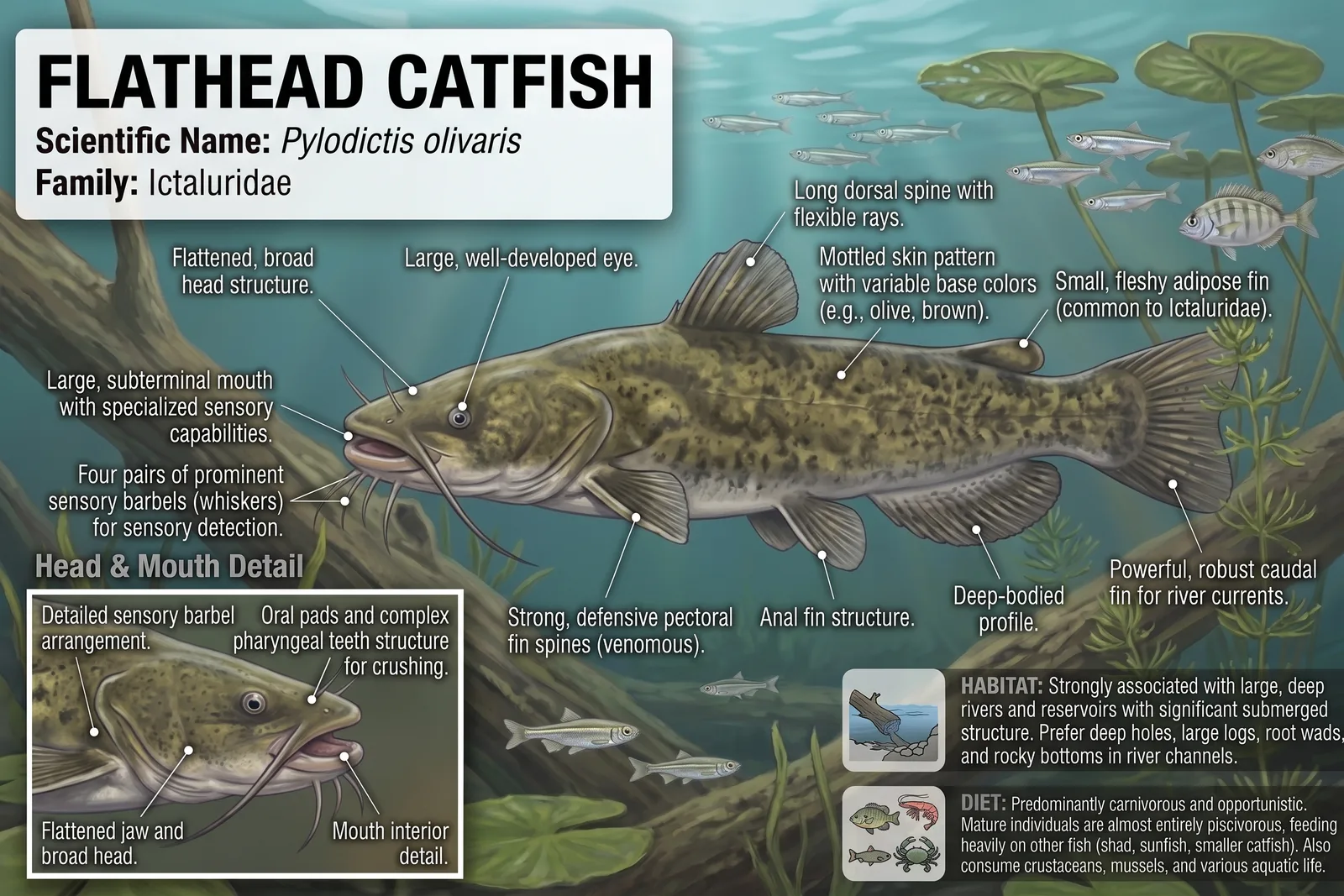
Flathead Catfish
Pylodictis olivaris · Ictaluridae
Also known as: Shovelhead, Yellow cat, Mud cat, Appaloosa
The live-bait specialist of the family, and the last of the three to spawn. Flatheads stop feeding while actively spawning, which makes the early-July lull biological rather than bad luck.
- Typical size
- 5–30 lb
- Max size
- Can exceed 100 lb.
- Water
- Freshwater
- Best season
- June before the spawn, and again from late July into autumn.
Identification
A broad, flattened head and a squared — not forked — tail, which separates it instantly from channel and blue catfish. Mottled yellow-brown to olive, with a projecting lower jaw.
Habitat & Range
Larger pools and deep holes in rivers and reservoirs, tight to old brushy tangles, submerged logs and undercut banks. Spawning fish excavate a saucer-shaped depression inside a natural cavity or beside a large submerged object.
Native to the Mississippi, Missouri and Ohio basins and the Gulf drainages; widely introduced elsewhere, where it is often an aggressive predator on native species.
Diet & Feeding
Almost entirely live fish and crayfish, with mussels, snails and insects taken occasionally. Flatheads rarely take cut or prepared bait, which is the practical difference from channel cats.
Spawning & Reproduction
Spawns in late June and July, distinctly later than channel catfish. The egg mass is a compact golden-yellow clump of 100,000 or more, and a parent agitates it continuously with fin movements to keep it oxygenated and free of silt. The male guards the fry for about a week after hatching.
Spawning windowSource-verified
- Run begins
- Jun 24
- Peak
- Jul 5
- Ends
- Jul 21
No temperature is given because no agency source publishes a flathead-specific one. Oklahoma's ODWC lists 75F, but that text is word-for-word identical on its channel and blue catfish pages, so it is boilerplate rather than a species finding, and it contradicts Missouri's explicit statement that flathead spawn later than channel. Window dates are MDC's observed north Missouri range: the last week of June to the third week of July.
Timing is modelled for a mid-latitude reference population — fish the thermometer, not the calendar. Based on 3 cited sources.
Spawning timing by location
Spawning tracks water temperature, so the calendar shifts with latitude and elevation. These break flathead catfish timing down by state and water body.
- When Do Flathead Catfish Spawn in Missouri?
Missouri flatheads spawn in late June and July — in north Missouri, from the last week of June to the third week of July. And they barely feed while they're at it, which explains the July lull.
How to Catch
Live bait, at night, tight to timber and deep holes. Plan around the spawn rather than through it: Missouri's agency notes flatheads feed heavily before and after spawning but seldom while actively spawning, which makes the first weeks of July the year's predictable dead spot.
Best techniques
- Live baiting
- Bank fishing at night
- Jug lining
- Drifting
Lures & baits
- Live bluegill
- Live shad
- Green sunfish
- Crayfish
Best season: June before the spawn, and again from late July into autumn.