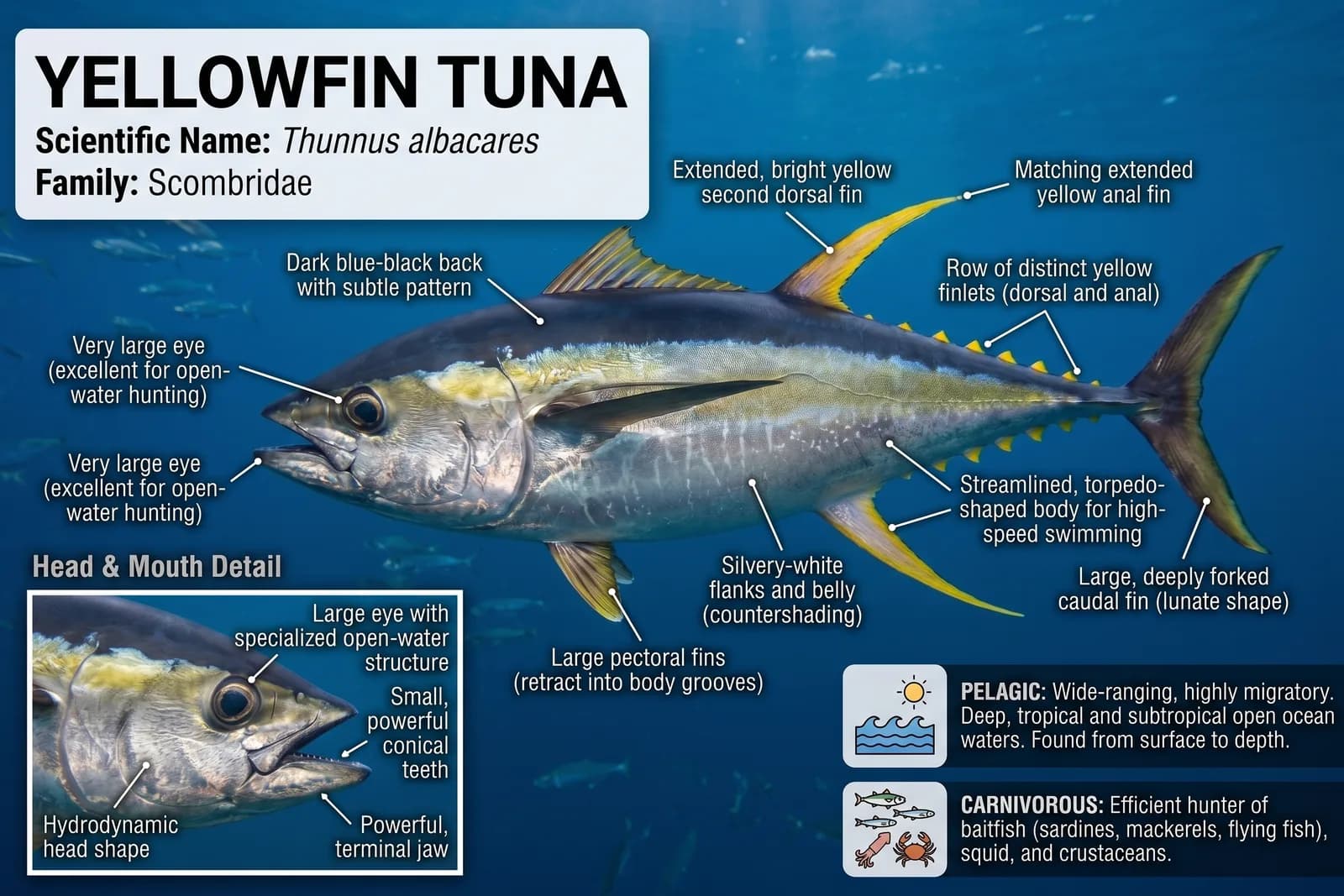
Yellowfin Tuna
Thunnus albacares · Scombridae
Also known as: Ahi, Allison tuna
A fish that reaches 400 pounds and dies of old age at six or seven. Yellowfin grow faster than almost anything else in the ocean, mature at two, and spawn nearly every day once they do — a life strategy that makes them both enormously productive and completely unlike the slow-growing gamefish most anglers are used to.
- Typical size
- 20–100 lb for most rod-caught fish
- Max size
- Up to 6 feet and 400 pounds, reached in a lifespan of only 6 to 7 years.
- Water
- Saltwater
- Best season
- Warm months, when the 64 to 88°F band they prefer pushes closest to shore. On most US coasts that is late summer into autumn.
Identification
Torpedo-shaped and metallic dark blue above, silver below, with a broad golden-yellow stripe along the flank. The name comes from the fins: the second dorsal and the anal fin are bright yellow and, on a large fish, grow into long sickle shapes that reach well back toward the tail. A row of small yellow finlets runs from those fins to the tail. Bigeye tuna are the common confusion — a bigeye has a larger eye and does not develop the long sickle fins.
Habitat & Range
Open ocean in tropical and subtropical waters, preferring 64 to 88°F. Young fish stay near the surface; older ones are often found in deeper water. They gather around drifting flotsam, fish aggregating devices, and around dolphins and other large marine animals — which is why locating tuna usually means locating something else first.
Worldwide in tropical and subtropical seas. In US waters that means the Pacific off California and Hawaii, the Gulf and the Atlantic. Both Pacific stocks assessed by NOAA — Eastern Pacific and Central and Western Pacific — are not overfished and not subject to overfishing.
Diet & Feeding
Fish, squid and crustaceans, taken near the top of the food chain. Adults are preyed on by marine mammals, billfish and sharks; young fish are eaten by other fish, seabirds and dolphins.
Spawning & Reproduction
Most yellowfin can reproduce by age 2, and females then spawn nearly every day, releasing millions of eggs each time. That extraordinary output is what lets a heavily fished, short-lived species sustain the catch it does.
Spawning timing by location
Spawning tracks water temperature, so the calendar shifts with latitude and elevation. These break yellowfin tuna timing down by state and water body.
- Yellowfin Tuna: Find the Thing They Are Under
A yellowfin can reach 400 pounds and will be dead of old age at six or seven. It matures at two and then spawns nearly every day. That life on fast-forward explains both why the stocks hold up under heavy fishing and why finding them means finding something they are gathered under.
How to Catch
Find the structure, not the fish. Yellowfin hold to anything that breaks open water — weed lines, flotsam, buoys, fish aggregating devices — and to dolphins and other large animals. Working porpoise is the classic offshore search pattern for exactly that reason. Trolling finds them; live bait, chunking or a jig takes them once found.
Best techniques
- Trolling
- Live-bait chunking
- Vertical jigging
- Kite fishing
Lures & baits
- Ballyhoo & skirted lures
- Live sardines/pilchards
- Vertical jigs
- Poppers
Best season: Warm months, when the 64 to 88°F band they prefer pushes closest to shore. On most US coasts that is late summer into autumn.
Frequently asked questions
- How big do yellowfin tuna get?
- Up to 6 feet long and 400 pounds, according to NOAA Fisheries. What makes that remarkable is the timescale: yellowfin have a somewhat short life span of 6 to 7 years, so a 400-pound fish got there in well under a decade.
- How do you tell a yellowfin from a bigeye tuna?
- The fins and the eye. A mature yellowfin develops long sickle-shaped second dorsal and anal fins that sweep back toward the tail, and both are bright yellow. A bigeye has a noticeably larger eye and keeps shorter fins. On small fish of either species the distinction is genuinely hard and is usually made on the liver by biologists, not on the boat.
- How do you find yellowfin tuna?
- By finding something else first. NOAA notes they gather around drifting flotsam, fish aggregating devices, and around dolphins and other large marine animals. Open water holds nothing; a weed line, a floating pallet or a working pod of porpoise holds bait, and bait holds tuna.
- What water temperature do yellowfin tuna prefer?
- Between 64 and 88°F. That band is what determines how close to shore they come and when, which is why offshore crews watch sea surface temperature charts rather than the calendar.
- Are yellowfin tuna overfished?
- Not in the Pacific. NOAA reports the Eastern Pacific stock as not overfished and not subject to overfishing on a 2023 assessment, and the Central and Western Pacific stock likewise on a 2020 assessment.
- How often do yellowfin tuna spawn?
- Nearly every day once mature, releasing millions of eggs each time. Most are able to reproduce by age 2. That output is what allows a short-lived species to support the fishery it does.
- Is there a size limit for yellowfin tuna?
- It depends where you are. NOAA's species page lists no federal size limit, notes that recreational anglers off California need a licence and that daily bag limits apply, and states that off Hawaii and the US Pacific Island territories there are no federal recreational regulations though local rules may apply. Check the agency for your water.
- What do yellowfin tuna eat?
- Fish, squid and crustaceans, taken near the top of the food chain. They are themselves prey for marine mammals, billfish and sharks as adults, and for other fish, seabirds and dolphins when young.