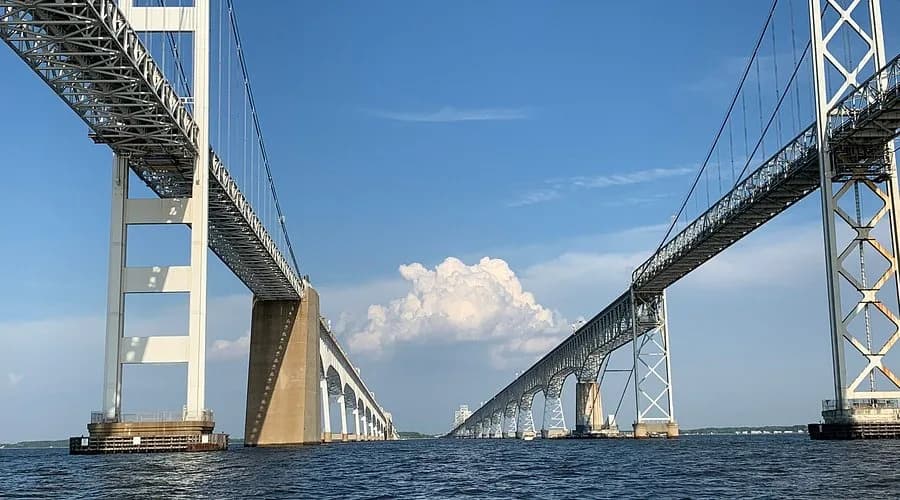
Maryland & Virginia · United States
Chesapeake Bay
BrackishThe largest estuary in the US is the nursery and migratory highway for East Coast striped bass. Trophy fish move through in spring, resident fish feed hard in fall, and a huge blue-catfish fishery runs all year.
- Water
- Brackish
- Best time
- Trophy stripers in spring, resident fish in fall; catfish year-round
Target species
Recommended techniques
- Trolling
- Chumming
- Light-tackle jigging
Best time of year: Trophy stripers in spring, resident fish in fall; catfish year-round
Live conditions at Chesapeake BayCurrent wind, wave height, water temperature and tide times from the nearest NOAA stations — plus any active weather warnings.The Chesapeake is the largest estuary in the United States, and the single most important thing to know about fishing it is a rule that catches visitors out every year.
In August, you may not fish for striped bass at all. Not "may not keep one" — may not fish for them.
The August closure, and what "target" means
The Code of Maryland Regulations, at 08.02.15.12I(5):
"During the period August 1 through August 31, a person may not target striped bass or striped bass hybrids in the Chesapeake Bay or its tidal tributaries."
And the same regulation defines the word:
"Target" means to catch, attempt to catch, harm, harass, or pursue.
Read those together. The prohibited act is casting at them, not keeping one. A month of catch-and-release striped bass fishing, which in most places is the uncontroversial compromise, is specifically what Maryland has closed.
Why a targeting closure rather than a harvest closure
Because the deaths happen during release.
Warm water holds less dissolved oxygen, and a fish played to exhaustion in August is working hardest exactly when the water can support it least. A striped bass released in those conditions very often dies afterwards, having swum off strongly. A harvest closure does nothing about that — the fish is still caught, fought and released. Only a targeting closure prevents it.
It is an unusually honest piece of regulation, and it is the reason the Maryland Bay has an empty month in the middle of its season.
The rules
Taken from the Code of Maryland Regulations, checked 18 October 2026. This is the Maryland side of the Bay; Virginia writes its own.
| Slot | 19″ minimum, 24″ maximum total length |
| Daily limit | 1 striped bass per day |
| Main season | 1 June – 5 December |
| Early areas | 1–15 May and 16–31 May, specified areas only |
| Closed to targeting | 1–31 August, Bay-wide |
| Spawning closure | 1 March – 31 May in designated spawning rivers and areas |
| Gaffs | Prohibited. Remove by hand or dip net only |
COMAR's wording on the slot is worth quoting because people misread it as a harvest rule: "A person may not catch or possess striped bass less than 19 inches" and "may not catch or possess striped bass greater than 24 inches." And on the limit: "A person may not catch or possess more than one striped bass per day."
That 19-to-24-inch window is five inches wide. A 26-inch fish goes back, the same design as the Montauk slot and Florida's bull redfish rule: protect the larger, more productive spawners and let anglers keep a smaller one.
The spawning closure has two exceptions
From 1 March through 31 May a person may not target striped bass in the designated spawning rivers and areas. Two hook-and-release exceptions exist for authorised recreational anglers:
- Susquehanna Flats and the Northeast River — March, hook and immediately release unharmed
- The Chester River north of Kent Narrows, in a defined area — March through May, same terms
The Susquehanna Flats catch-and-release fishery in early spring is a genuinely famous one, and it exists inside a closure rather than outside it.
Two gear rules people miss
No gaffs, ever. COMAR: "A person may not use a gaff or similar device to remove striped bass from the water", and a striped bass may be removed "only by hand or dip net." That is not conditional on whether you are keeping it. A rubber-coated net is the right tool and is kinder to the fish than hands anyway.
Eels as bait are seasonal. COMAR 08.02.05.02 allows eels as bait with hook and line in tidal waters from 16 May to 31 July and from 1 September to 5 December. Note what sits in the gap — August, the closed month.
There is also a treble hook restriction within 1,200 feet of certain piers of the Bay Bridge, where a treble is only allowed as an intrinsic part of a floating lure. That one applies to all fishing, not just striped bass.
What else is there
Striped bass — rockfish, locally — dominate the Bay's reputation, but the August gap is a good reason to know the rest of the card.
- Blue catfish — invasive, abundant, under no meaningful limit, and genuinely good eating. Fishing for them is actively encouraged. See our blue catfish page.
- Cobia — a summer visitor to the lower Bay, and a serious fish on light tackle.
- Spanish mackerel — fast, schooling, and a reliable August target precisely when stripers are off the table.
- Speckled trout and red drum in the lower Bay and the marshes.
August is not a dead month. It is a month to fish for something else, and the Bay gives you options.
Before you go
- Check which state's water you are in. The Bay is split, and Maryland and Virginia do not match.
- Check the calendar against the closures — August entirely, and March to May in the spawning areas.
- Carry a dip net, not a gaff.
- Check the water temperature. Our live conditions tool reads the nearest NOAA station; in the shoulder months around the closure it tells you more about release survival than the date does.
- Re-read the regulation. Every figure here is dated and linked below, and Maryland amends this chapter often.
Sources
- COMAR 08.02.15.09, Recreational and Charter Boat Striped Bass Fishery in the Chesapeake Bay and Its Tidal Tributaries — Code of Maryland Regulations — that a person may not catch or possess striped bass less than 19 inches in total length or greater than 24 inches in total length; that a person may not catch or possess more than one striped bass per day; the 1 June to 5 December season across the Bay and its tidal tributaries; and the restricted-area openings of 1–15 May and 16–31 May.
- COMAR 08.02.15.12, General Restrictions — subsection I(5), that during 1 August through 31 August a person may not target striped bass or striped bass hybrids in the Chesapeake Bay or its tidal tributaries; I(1)(b), that "target" means to catch, attempt to catch, harm, harass, or pursue; I(2), the 1 March to 31 May prohibition on targeting in the spawning rivers and areas; I(3) and I(4), the hook-and-release exceptions for the Susquehanna Flats and Northeast River in March and for a defined area of the Chester River north of Kent Narrows from March through May; and section A, that a person may not use a gaff or similar device to remove striped bass from the water and that a striped bass may be removed only by hand or dip net.
- COMAR 08.02.05.02, General Fishing Prohibitions — that eels may be used as bait with hook and line in tidal waters from 16 May through 31 July and from 1 September through 5 December, and the treble hook restriction within 1,200 feet of certain piers of the William Preston Lane Jr. Memorial Bay Bridge.
Frequently asked questions
- Can you fish for striped bass in the Chesapeake in August?
- No. COMAR 08.02.15.12I(5) states that during the period August 1 through August 31, a person may not target striped bass or striped bass hybrids in the Chesapeake Bay or its tidal tributaries. And the regulation defines target as to catch, attempt to catch, harm, harass, or pursue — so casting at them is the prohibited act, not keeping one. Checked against the Code of Maryland Regulations on 18 October 2026.
- What is the striped bass size limit in the Chesapeake Bay?
- In Maryland waters, a 19 to 24 inch slot. COMAR states a person may not catch or possess striped bass less than 19 inches in total length, and may not catch or possess striped bass greater than 24 inches in total length. The daily limit is one fish: a person may not catch or possess more than one striped bass per day.
- When is striped bass season in the Maryland Chesapeake?
- The main season runs 1 June through 5 December across the Bay and its tidal tributaries, with the August closure inside it. Earlier, 1 to 15 May and 16 to 31 May open only specified areas rather than the whole Bay. Dates and boundaries change, so check COMAR or DNR before you fish.
- Why does Maryland close striped bass fishing in August?
- Heat. Warm water holds less oxygen and a striped bass played and released in August frequently dies afterwards even when it swims off strongly. Closing targeting rather than just harvest is the only measure that actually prevents that, because the mortality happens during catch and release, not at the cooler.
- Can you gaff a striped bass in Maryland?
- No. COMAR 08.02.15.12 states that a person may not use a gaff or similar device to remove striped bass from the water, and that a striped bass may be removed only by hand or dip net. That applies whatever you intend to do with the fish.
- When can you use eels as bait in the Chesapeake?
- COMAR 08.02.05.02 permits eels as bait with hook and line in tidal waters from 16 May through 31 July and from 1 September through 5 December. Note the gap: the window deliberately excludes August, the month targeting is closed.
- Are there spawning closures in the Chesapeake?
- Yes. From 1 March through 31 May a person may not target striped bass in the designated spawning rivers and areas. Two hook-and-release exceptions exist for authorised anglers: the Susquehanna Flats and Northeast River in March, and a defined area of the Chester River north of Kent Narrows from March through May.
- Do Maryland and Virginia have the same Chesapeake rules?
- No. The Bay is split between the two states, and each writes its own seasons, sizes and limits. Everything on this page is the Maryland side, taken from the Code of Maryland Regulations. If you are fishing the lower Bay, check the Virginia Marine Resources Commission instead.