Brook Trout
Salvelinus fontinalis · Salmonidae
Also known as: Brookie, Speckled trout, Squaretail, Char, Salter (anadromous form)
Not a trout at all but a char, and the native coldwater fish of eastern North America. Brook trout spawn over groundwater upwelling rather than at a particular date, which is what makes their redds findable.
- Typical size
- 15–30 cm (6–12 in), often much smaller in headwater streams
- Max size
- Lake and sea-run fish exceed 3 kg (6 lb); stream fish over 40 cm (16 in) are exceptional.
- Water
- Freshwater
- Best season
- Late spring through early autumn; spawning runs from late September.
Identification
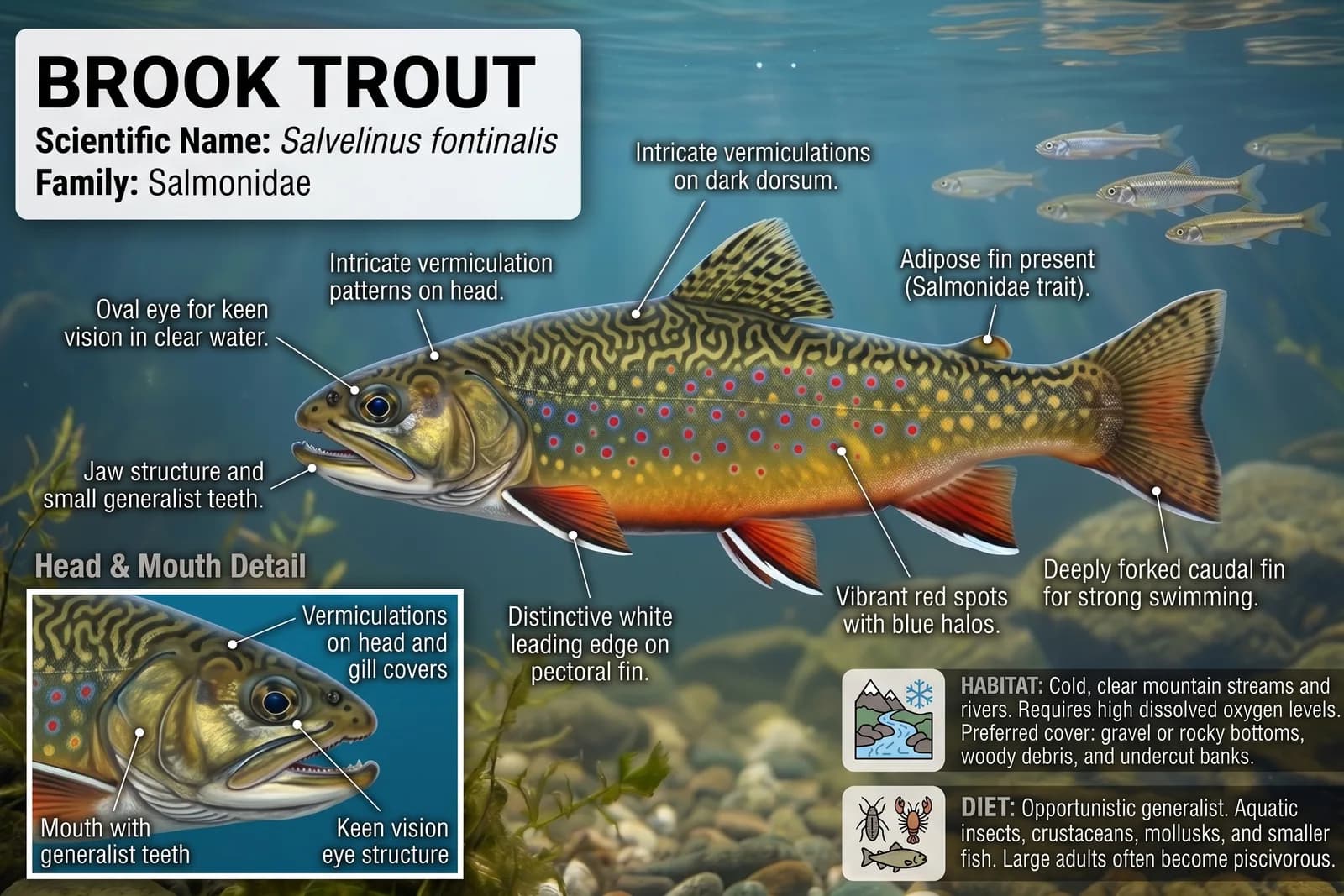
White leading edges on the lower fins are the giveaway. Worm-like pale vermiculations run over the back and dorsal fin, and the flanks carry red spots ringed with blue halos — brown trout have red spots with pale halos, never blue. Spawning males colour to fiery red along the lower flank with black pigment, and develop a kype.
Habitat & Range
Cold, clean, well-oxygenated streams, spring ponds and lakes. Requires water below about 68°F for sustained periods and oxygen at 5 ppm or better; retreats to headwaters and spring seeps as summer water warms.
Native to eastern North America from Labrador and Quebec through the Great Lakes and down the Appalachians; widely introduced in the western US and abroad. Anadromous "salter" populations feed in estuaries for 40 to 90 days a year.
Diet & Feeding
Aquatic insects, terrestrials, crustaceans and small fish. Opportunistic and less selective than brown trout, which is why they are the classic small-stream fish for a new angler.
Spawning & Reproduction
Autumn spawner, from late September into November, and in some shore-spawning ponds from mid-November into January. The female digs a redd 4 to 12 inches deep in gravel sited over upwelling groundwater — the upwelling keeps eggs from freezing and supplies oxygen through the winter. Unusually among salmonids, courtship and spawning happen in daylight.
Spawning windowSource-verified
- Run begins
- Sep 25
- Peak
- Oct 20
- Ends
- Nov 30
- Redd temperature
- 43–53°F
The useful range is not a single trigger figure. Hokanson et al. (1973) found ovulation and spawning occur at 16C (61F) and below, but viable eggs per female fall off above 11.7C (53F), normal hatch above 12.7C (55F), and the optimum for embryo survival is near 6C (43F). That gap is why brook trout site redds over groundwater upwelling, which holds close to the optimum all winter. In Maine the earliest spawning is in high-elevation and more northern waters, reversing the usual pattern.
Timing is modelled for a mid-latitude reference population — fish the thermometer, not the calendar. Based on 3 cited sources.
Spawning timing by location
Spawning tracks water temperature, so the calendar shifts with latitude and elevation. These break brook trout timing down by state and water body.
- When Do Brook Trout Spawn in Maine?
Maine brook trout spawn from late September into November in streams. But shore-spawning pond fish don't start until mid-November, and some are still at it in January — two strategies, three months apart.
- When Do Brook Trout Spawn in Michigan?
Michigan brook trout spawn in October and November — but the date matters less than the place. They build redds over groundwater seepage, and in the U.P. that's what tells you where to look.
- When Do Brook Trout Spawn in Wisconsin?
Wisconsin brook trout spawn from late September into November over groundwater seeps. As with brown trout, the inland stream season closes 15 October — so much of the spawn happens with the season shut.
How to Catch
Fish small water and move constantly — a brook trout stream fishes best at walking pace, one cast per likely pocket. They hold in the coldest water available, so in summer work upstream toward springs and seeps. Approach low: in clear headwater streams they see you long before you see them.
Best techniques
- Fly fishing (dry fly, nymph, small streamer)
- Ultralight spinning
- Small-stream stalking
Lures & baits
- Small spinners
- Elk hair caddis
- Beadhead nymphs
- Worms
Best season: Late spring through early autumn; spawning runs from late September.