When Do Brook Trout Spawn in Maine?
Maine brook trout spawn from late September into November in streams. But shore-spawning pond fish don't start until mid-November, and some are still at it in January — two strategies, three months apart.
Published
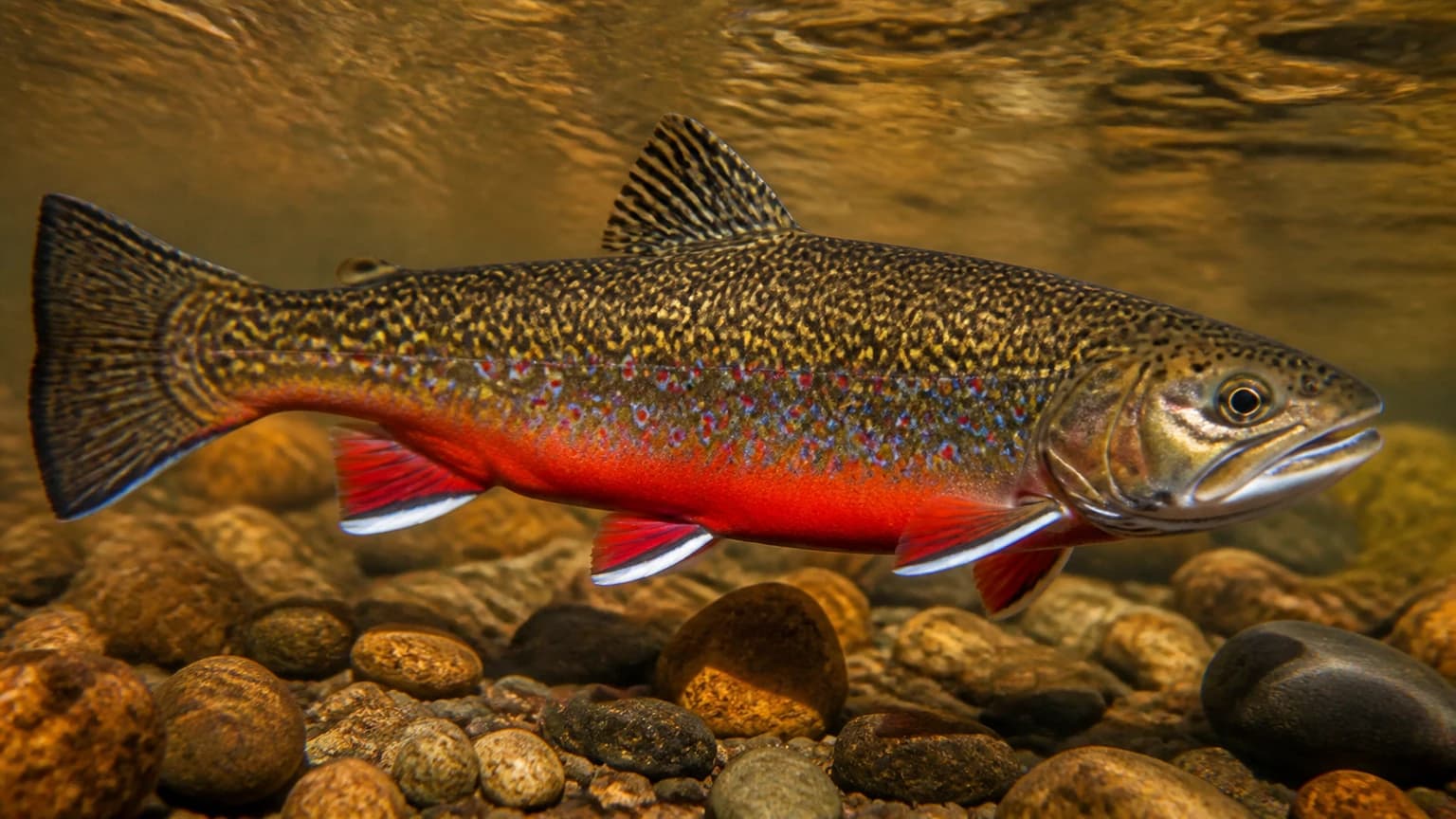
Maine brook trout spawn from late September into November, over gravel sited on upwelling groundwater. But that only covers the stream fish. Pond shore-spawners do not start until mid-November, and some are still spawning in January.
Two spawns, three months apart
Maine IFW documents both strategies in the same state, and they barely overlap.
| Type | Where | When |
|---|---|---|
| Tributary spawners | Streams entering lakes and ponds | Late September – November. Moosehead Lake fish enter tributaries in early October |
| Shore spawners | Ponds with spring inflow over gravelly or sandy shallows | Mid-November, with some still spawning into January |
If you have been told "brook trout spawn in October in Maine," that is true for the tributary fish and wrong by two months for the shore spawners. On a pond with strong spring seeps, November and December are the spawn — not the aftermath.
The temperature answer everyone gets wrong
Nearly every page will tell you brook trout spawn at around 45°F. That is a made-up precision, and the real numbers are more useful.
A study of brook trout thermal requirements measured four separate thresholds:
| Threshold | Temperature |
|---|---|
| Ovulation and spawning still occur at | 61°F and below |
| Males functionally mature (motile sperm) up to | 66°F |
| Viable eggs per female drop by half above | 53°F |
| Normal hatch drops by half above | 55°F |
| Optimum for embryo survival | ~43°F |
Read that again, because it is the whole story: brook trout can spawn at 61°F, but the eggs will not survive it. Viability is already collapsing at 53°F, and the optimum is a full ten degrees below that.
So the fish are not looking for a temperature to spawn at. They are looking for a place where the eggs will sit at roughly 43°F for the next several months, whatever the surface water does.
Which is why the redd is where it is
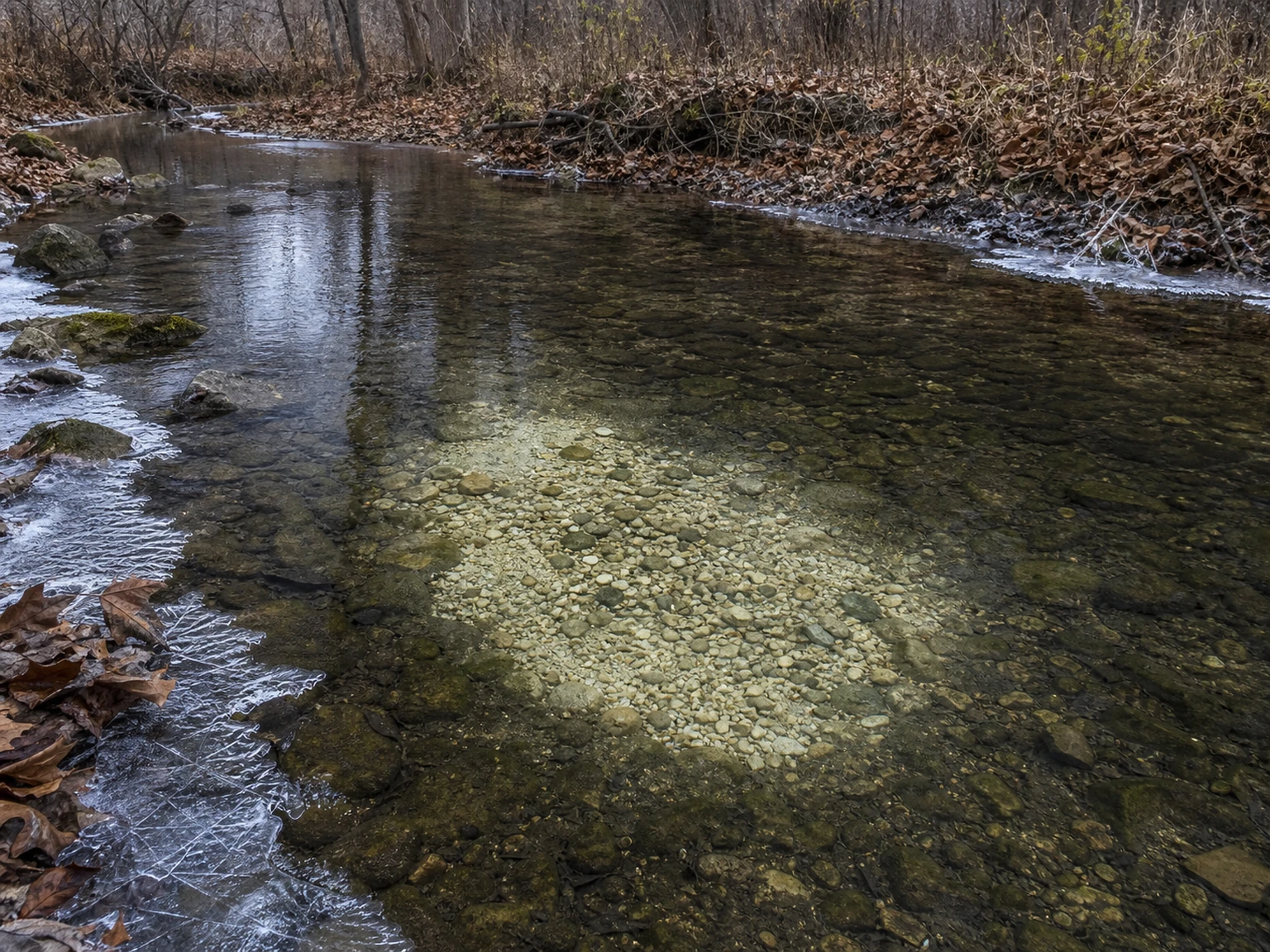
Maine IFW is precise about this. Brook trout "spawn in gravelly substrate over upwelling ground water," because "water moving through the gravel prevents the buried eggs from freezing and provides them with oxygen."
Groundwater emerges at close to the mean annual air temperature and barely moves with the season. In Maine that puts it near the 43°F optimum — in autumn, in January, in March. A seep is a thermal refuge for eggs, and a brook trout redd is an expression of that.
For an angler this is a map. You are not scanning for gravel. You are scanning for gravel with a spring in it:
- Places where the streambed stays open when the margins ice over.
- Patches that fog or steam on a cold morning.
- Streambed gravel that is conspicuously clean while everything around it is silted.
- On ponds: gravelly or sandy shallows with visible inflow.
The northern-and-higher-is-earlier rule
Here is where brook trout reverse what you expect. Maine IFW: "the earliest spawning occurs in high-elevation waters and/or more northern latitudes."
For most fish the south goes first. For brook trout, the coldest water reaches spawning condition first, so Aroostook County and the high ponds are early, and southern lowland streams are late.
| Region | Redds start | Peak |
|---|---|---|
| Northern Maine, high-elevation ponds and streams | Mid-to-late September | Early-to-mid October |
| Central Maine and the Moosehead region | Late September | Early-to-mid October (tributary run) |
| Southern and coastal Maine | Early-to-mid October | Late October – early November |
| Pond shore-spawners, statewide | Mid-November | Late November – December, into January |
This table is modelled, not measured, apart from the two anchors that are not: the Moosehead tributary run in early October and the mid-November shore-spawn start, both from Maine IFW. Everything else applies the "coldest water first" rule to Maine's autumn cooling. Carry a thermometer.
What the redd looks like, and the daytime quirk
The female lies on her side and beats her tail to excavate a pit 4 to 12 inches deep, which also cleans silt and debris from the gravel. One or two males move in alongside her and eggs and milt are released together. The eggs are briefly adhesive so the current does not carry them off, and she then covers them with gravel.
One detail worth knowing if you want to watch rather than fish: brook trout court and spawn in the daytime — the opposite of lake trout. An October afternoon over a clean gravel patch is genuinely a thing you can go and see.
Fishing it, and the rules
Maine's brook trout waters were historically closed after 30 September specifically to protect spawning fish. Since 2002, October fishing has been extended on many stocked lakes and ponds — but under restrictive gear rules and catch-and-release only.
That is the shape of it: Maine has decided this question largely on your behalf, and where it has not, the intent is obvious. Check the current Maine IFW fishing laws for the specific water, because these are water-by-water rules and they change.
Where you can fish:
- Pre-spawn (September). Fish are staging near tributary mouths and moving up. Aggressive and worth targeting.
- Spawn. Fish below the redds, not on them. Trout holding downstream of spawning gravel are eating drifting eggs. Paired fish on clean gravel are not targets — and do not wade across clean gravel, because the eggs sit in it until spring.
- Post-spawn (late November into winter). Spent fish drop back to deeper holding water, thin and hungry.
A note on what you are actually holding
Brook trout are not trout. They are char — genus Salvelinus, like lake trout and Arctic char — and Maine's native coldwater fish.
The identification is easy once you know it: white leading edges on the lower fins, pale worm-like vermiculations over the back and dorsal, and red spots ringed with blue halos. Brown trout have red spots with pale halos, never blue. Spawning males turn fiery red along the lower flank with black pigment and grow a kype.
Maine also holds anadromous "salters" — sea-run brook trout that spend 40 to 90 days a year feeding in estuaries. They are a genuine rarity in the modern range.
Related
Sources
- Brook Trout: Biology & Management — Maine Dept of Inland Fisheries and Wildlife (PDF) — late September–November spawning over upwelling groundwater; redd depth 4–12 inches; daytime spawning; earliest spawning at high elevation and northern latitudes; 68°F and 5 ppm limits; anadromous salters feeding 40–90 days in estuaries.
- Brook Trout: Species Information — Maine IFW — Moosehead tributary spawners in early October; shore spawners from mid-November into January; the historic 30 September closure and the post-2002 October catch-and-release extension.
- Hokanson, K. E. F., J. H. McCormick, B. R. Jones, and J. H. Tucker. 1973. Thermal requirements for maturation, spawning, and embryo survival of the brook trout, Salvelinus fontinalis. Journal of the Fisheries Research Board of Canada 30(7):975–984 — spawning at ≤16°C (61°F), viability ET50 at 11.7°C (53°F), hatch TL50 at 12.7°C (55°F), optimum near 6°C (43°F).
The regional timing table is modelled apart from the two Maine IFW anchors named in it. It applies the "coldest water reaches spawning condition first" rule to Maine's autumn cooling. Confirm with a thermometer before planning a trip.
Frequently asked questions
- When do brook trout spawn in Maine?
- Stream and tributary spawners run from late September through November — Moosehead Lake fish enter tributaries in early October. Pond shore-spawners are entirely different: Maine IFW records them beginning in mid-November, with some still spawning into January.
- What water temperature do brook trout spawn at?
- There is no single figure. Research found ovulation and spawning occur at 61°F and below, but viable eggs per female drop off above 53°F, normal hatch above 55°F, and the optimum for embryo survival is near 43°F. That gap is why brook trout spawn over groundwater upwelling rather than at a particular date.
- Where do brook trout build redds?
- In gravel sited over upwelling groundwater — in stream riffles, in pond seepage areas, and on lake shores with current or seeps. The upwelling keeps eggs from freezing and supplies oxygen all winter. The female digs a pit 4 to 12 inches deep by lying on her side and beating her tail.
- Can you fish for brook trout in Maine during the spawn?
- It depends on the water. Brook trout waters were historically closed after 30 September to protect spawning fish. Since 2002 October fishing has been extended on many stocked lakes and ponds, but under restrictive gear rules and catch-and-release only. Check the current Maine IFW law book for the specific water.
- Do brook trout in northern Maine spawn later than in the south?
- No — earlier. Maine IFW states the earliest spawning occurs in high-elevation waters and more northern latitudes. Brook trout need cold water to spawn, so the coldest water reaches spawning condition first, which reverses the pattern most anglers expect.
Gear for this
 AccessoriesCheck price on Amazon
Stream & Lake Water Thermometer
The one piece of kit every spawn article on this site tells you to carry.
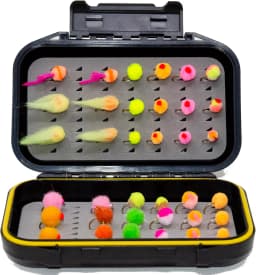 LuresCheck price on Amazon
Egg Patterns & Beads
The presentation every spawn article here points you at — fished below the redds, not on them.
- Check price on Amazon
ChronicAnglers is reader-supported. When you buy through links on our site, we may earn an affiliate commission at no extra cost to you.