Bluefish: How to Catch Them, and Why You Need a Bite Trace
NOAA puts it plainly: once a bluefish is grown, only sharks, tunas and billfishes are large and fast enough to prey on it. That tells you most of what you need to know about how to fish for them — and why the last twelve inches of your rig decide whether you land anything.
Published
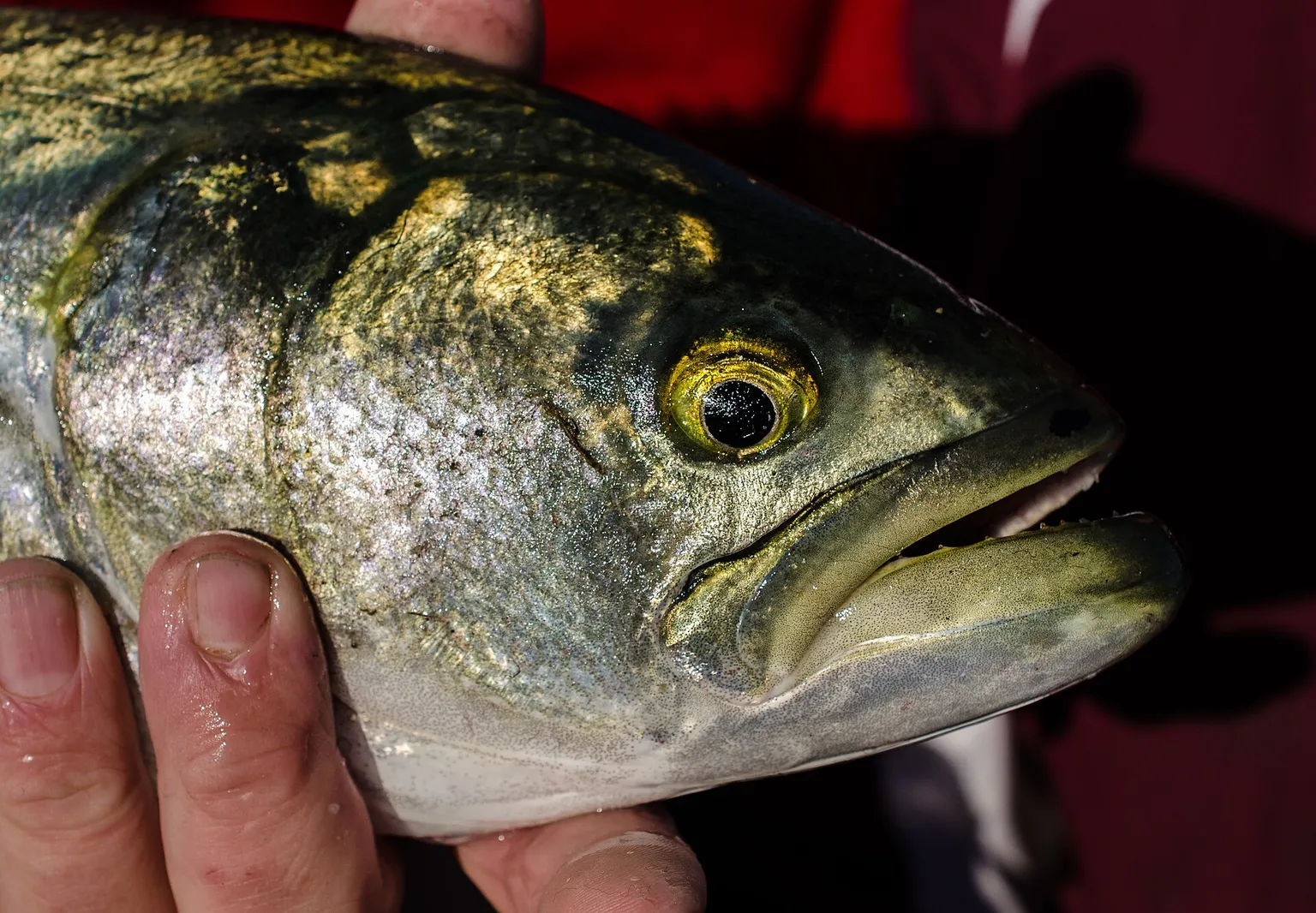
Only sharks, tunas and billfishes are typically large and fast enough to prey on an adult bluefish. That is NOAA Fisheries' assessment, not an angler's boast.
Hold that in mind and most decisions about how to fish for them answer themselves — starting with the last twelve inches of your rig.
The teeth are the whole problem
NOAA describes razor-sharp teeth and shearing jaws, and notes those jaws are what let bluefish take unusually large prey for their size.
For an angler that translates into one unavoidable fact: ordinary leader does not survive contact. Monofilament, standard-diameter fluorocarbon and braid all cut. You will lose the lure, and worse, you will leave it in the fish.
So you fish a bite trace:
- Short wire trace — the surest answer. A few inches of single-strand or knottable wire above the lure. You will get fewer bites in clear water, and you will land what bites.
- Heavy fluorocarbon shock length — the compromise. Much heavier than you would use for anything else on the same tackle. Our fluorocarbon guide covers which materials actually resist abrasion, because not all of them do.
This is the same warning our Montauk guide, our Outer Banks guide and our northern pike article all carry. Different oceans, different fish, identical problem: teeth and ordinary line are not compatible.
And keep your fingers out of the mouth. Use long pliers or a dehooker — see our pliers guide. Bluefish injuries are common and entirely avoidable.
The blitz
This is why people chase them.
NOAA's own description of bluefish feeding is that large schools attack bait near the surface, churning the water like a washing machine. Bait gets pinned against the beach or trapped at the surface, birds work the scraps above it, and several hundred yards of water boils.
It is the most visible feeding event in inshore fishing, and it is findable: look for the birds. A blitz is usually spotted before it is cast at.
Two things to know when you are in one:
- It moves. A blitz travels with the bait. Chasing it down the beach at a run is normal.
- It ends. Sometimes in ten minutes. Have the rod rigged before you find one, not after.
When, and where
NOAA places bluefish along the US East Coast from Maine to eastern Florida, moving north in spring and summer as water warms and south in autumn and winter into the South Atlantic Bight.
That southward autumn movement, following bait down the beach, is what produces the famous fall runs — the same mechanism driving the Montauk and Cape Hatteras seasons, and the reason striped bass and bluefish so often show up together.
Because it is a temperature and bait event rather than a date, the calendar is a weak guide. Our live conditions tool shows current water temperature at the nearest NOAA station, which is a better signal.
What to throw
Bluefish hunt by sight and speed, and they are not subtle.
- Metal — tins and casting spoons. Heavy enough to reach the fish, fast enough to trigger a chase.
- Poppers on the surface during a blitz, which is as good as inshore fishing gets.
- Swimming plugs and large soft plastics when they are deeper.
- Cut bait on the bottom, which works and costs you far more terminal tackle.
Retrieve fast. A bluefish commits to something fleeing and inspects something slow.
Expect to lose lures anyway. Fish you intend to keep can be taken on cheap metal; save the expensive plugs for fish that are not actively shredding them.
The limits
Checked with NOAA Fisheries on 18 October 2026. States set their own rules on top of the federal ones, and the state agency is the authority for the water you are standing in.
| Federal bag limit | 5 per person per day, private vessel |
| For-hire vessel | 7 per person per day |
| Federal size limit | None |
| Stock status | Not overfished, not subject to overfishing (2025 assessment) |
| Rebuilding target | 2029 |
The fishery is managed jointly by NOAA Fisheries, the Mid-Atlantic Fishery Management Council and the Atlantic States Marine Fisheries Commission, and most of the annual catch limit is allocated to the recreational fishery rather than the commercial one.
Size and age
NOAA gives a maximum of 31 pounds and 39 inches, and a lifespan of up to 12 years.
They mature at age 2, at roughly 15 to 20 inches, and females produce 400,000 to 2 million eggs depending on size, released in the open ocean across multiple spawnings in spring and summer.
The small ones — the ones most people meet first — are called snappers, and they are the fish that gets a great many children into fishing. They also have the same teeth.
Eating them
Bluefish have a reputation as poor eating, and it is mostly undeserved. It is a handling problem.
They are oily and strongly flavoured, and that oil turns quickly. Bleed them and get them on ice immediately, and eat them fresh rather than freezing. A fish bled at the rail and iced is good; the same fish left in a warm boat for two hours is the one that gave bluefish their reputation.
If you are releasing instead, the handling rules are the ones in our catch and release guide — with the addition that you should never put a hand near the mouth.
Related
- Bluefish — identification, range and diet
- Montauk · Outer Banks — where the autumn runs happen
- Top 5 fluorocarbon leaders — what actually resists abrasion
- Top 5 fishing pliers — long jaws are a safety feature here
- Catch and release, done right
Sources
- Bluefish — NOAA Fisheries — that the stock is not overfished and not subject to overfishing based on a 2025 stock assessment, and is rebuilding under a plan targeting 2029; a lifespan of up to 12 years and a maximum of 31 pounds and 39 inches; maturity at age 2 at roughly 15 to 20 inches with females producing 400,000 to 2 million eggs released in the open ocean across multiple spawnings in spring and summer; a diet of squid and fish, especially menhaden and small fish such as silversides; razor-sharp teeth and shearing jaws allowing them to take large prey; that only sharks, tunas and billfishes are typically large and fast enough to prey on adults; feeding schools churning the water like a washing machine; a range from Maine to eastern Florida with northward movement in spring and summer and southward movement in autumn and winter to the South Atlantic Bight; joint management by NOAA Fisheries, the Mid-Atlantic Fishery Management Council and the Atlantic States Marine Fisheries Commission; and recreational bag limits of 5 fish per person per day for private vessels and 7 for for-hire vessels with no federal size limit.
Frequently asked questions
- Do you need a wire trace for bluefish?
- You need a bite trace of some kind, and wire is the surest. Bluefish have what NOAA describes as razor-sharp teeth and shearing jaws, and they cut straight through ordinary monofilament, standard fluorocarbon leader and braid. A short wire trace or a heavy fluorocarbon shock length is the difference between landing fish and donating lures.
- How big do bluefish get?
- NOAA Fisheries gives a maximum of 31 pounds and 39 inches, with a lifespan of up to 12 years. Most fish an angler meets are far smaller — the small ones are called snappers — but a fish of that size on light tackle is a genuinely serious proposition.
- What is a bluefish blitz?
- A large school attacking bait near the surface. NOAA's description is that they churn the water like a washing machine. Bait gets pinned against the beach or the surface, birds work above it, and the water boils. It is the most visible feeding event in inshore fishing and the reason people chase bluefish at all.
- What is the bag limit for bluefish?
- Federally, 5 fish per person per day from a private vessel and 7 from a for-hire vessel, with no federal size limit. States may be stricter, so check the agency for the water you are fishing. New York, for example, applies the same 5 and 7 split with no size limit.
- Are bluefish overfished?
- No. Based on a 2025 stock assessment NOAA Fisheries reports the stock is not overfished and not subject to overfishing, and it is rebuilding under a plan targeting 2029. That is a better position than the fishery was in a few years ago.
- When is the best time to catch bluefish?
- Autumn, in most of the range. NOAA describes bluefish moving north in spring and summer as waters warm, then south in autumn and winter to the South Atlantic Bight. That southward movement, following bait down the beach, is what produces the famous fall blitzes.
- What do bluefish eat?
- Squid and fish, with NOAA naming menhaden and small fish such as silversides specifically. They take large prey for their size because of their shearing jaws. Match the bait that is actually present rather than the lure that worked last season.
- Are bluefish good to eat?
- They are oily and strongly flavoured, and the difference between good and poor bluefish on the plate is almost entirely handling. Bleed and ice them immediately, and eat them fresh rather than freezing. A bluefish treated casually for two hours in a warm boat is a different fish from one bled at the rail.