North Carolina · United States
Outer Banks (Cape Hatteras)
SaltwaterWhere the Gulf Stream swings close to a chain of barrier islands, Cape Hatteras offers some of the best surf fishing in the country. The autumn red-drum run is the headline event, with big fish landed straight off the beach.
- Water
- Saltwater
- Best time
- Fall red-drum run Oct–Nov; cobia in spring
Target species
Recommended techniques
- Surf fishing
- Pier fishing
- Nearshore trolling
Best time of year: Fall red-drum run Oct–Nov; cobia in spring
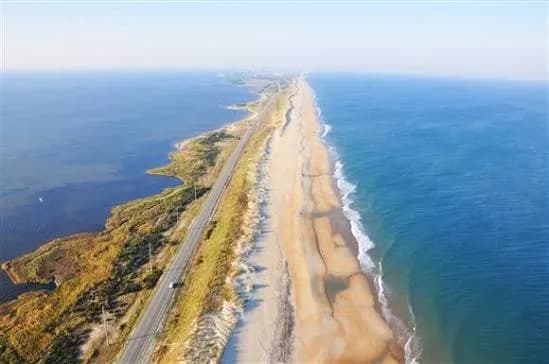
Live conditions at Outer Banks (Cape Hatteras)Current wind, wave height, water temperature and tide times from the nearest NOAA stations — plus any active weather warnings.The Outer Banks is a thin chain of barrier islands with the Atlantic on one side and sounds on the other, and almost everything about the fishing follows from one fact: the cold Labrador Current and the warm Gulf Stream converge off Cape Hatteras. That meeting point is why a single stretch of sand holds both northern and southern species, and why the offshore fleet out of Hatteras reaches bluewater faster than almost anywhere else on the east coast.
For a shore angler the appeal is simpler. Miles of open, drivable beach, deep sloughs close in, and red drum.
Two permits, and only one of them is a fishing licence
This is where Outer Banks trips go wrong, because the two are unrelated and people assume the one covers the other.
1. The fishing licence
North Carolina requires a Coastal Recreational Fishing License. DMF's wording: "Persons engaged in recreational fishing in North Carolina coastal waters are required to possess a" Coastal Recreational Fishing License under G.S. 113-174.2.
2. The beach driving permit
If you intend to drive the sand inside Cape Hatteras National Seashore, you need a National Park Service off-road vehicle permit, and it has rules that catch people out:
| 10-day permit | $50, valid 10 consecutive days |
| Annual permit | $120, valid one year from purchase |
| Where | Online only, through Recreation.gov |
| Vehicle | One vehicle. "Permits are non-transferable to another vehicle." |
| Proof | "You must print all three pages of the permit. Digital proof of payment, including screenshots, are not acceptable." |
Read that last row twice. A screenshot on your phone is not a permit. If you cannot print, NPS allows a self-certification card from a visitor centre or a local tackle shop, filled in and displayed — but that is a fallback, not the plan.
Checked with NPS on 18 October 2026.
Ramp status and seasonal closures change constantly, for sea turtle nesting, shorebirds and safety. NPS publishes current beach access at go.nps.gov/beachaccess and runs a text alert service. Check it the morning you drive, not the week before.
The rules change mid-season, and that is the point
Most states publish a table and leave it. North Carolina manages a great deal by proclamation, which DMF can issue during a season.
The clearest example is in the table itself: cobia carries no numeric size or bag limit at all — just an instruction to "See the most recent Cobia DMF proclamation."
And as of 18 October 2026 the Atlantic Ocean striped bass row says "UNLAWFUL TO POSSESS" while its own footnote gives "Year-round: 1 per person per day and a harvest slot limit of 28 inches to 31 inches TL." Those two statements are not compatible. We are not going to guess which one governs — ask DMF before you keep a striper here.
That is the honest state of it, and it is more useful than a confident number. If you take one thing from this page: in North Carolina, the table is a starting point and the proclamation is the law.
What is there, and the limits
Checked with NC DMF on 18 October 2026. The agency is the authority, not this page.
| Species | Size | Daily bag |
|---|---|---|
| Red drum | 18″ – 27″ TL slot | 1 |
| Spotted seatrout | 14″ – 20″ TL, plus 1 over 26″ | 3 |
| Bluefish | No minimum | 5 (7 for for-hire passengers) |
| Spanish mackerel | 12″ fork length | 15 |
| Striped bass (Atlantic) | See above — the page conflicts | — |
| Cobia | No figure in the table | See the current proclamation |
Two red drum footnotes worth knowing: it is unlawful to possess a red drum greater than 27 inches, and it is unlawful to gig, spear or gaff red drum at all.
That 27-inch ceiling is the same design as Florida's. A big autumn drum on the Outer Banks is a mandatory release, and it is a spawning adult — our bull redfish page covers why the rule is drawn exactly there and how FWC asks you to handle one. The handling advice does not change at the state line.
Where to stand
- Cape Point (Buxton) — the famous one. Where the shoals run out and the currents meet. Big drum water, heavy current, and the most crowded sand on the island in autumn.
- Hatteras Inlet and Oregon Inlet — moving water, bait funnels, and the classic inlet pattern on a running tide.
- The sloughs anywhere along the beach — the deeper troughs between sandbars. Learning to read these matters more here than knowing any place name, because the sandbars move every winter. Our reading water guide covers the shapes.
- Soundside — shallow, grassy, and a completely different fishery for speckled trout and puppy drum, out of the wind when the ocean is unfishable.
- The piers — Avon, Rodanthe, Jennette's. No ORV permit needed, which makes them the sensible first stop on a trip.
When
Autumn is the season, and the mechanism is the same one that drives Montauk: falling water temperature, bait leaving, predators following. Large red drum move along the beach in the fall, and the big-drum reputation of Cape Point is built on it.
Spring gives a second, smaller run. Summer is Spanish mackerel, bluefish and offshore. Winter is quiet on the beach and serious offshore for bluefin out of Hatteras.
Because it is a temperature event, the calendar is a weak guide. Live conditions for the Outer Banks pulls current water temperature, wind, wave height and tide from the nearest NOAA stations — and on this coast, wave height decides whether you fish at all. A big northeast swell makes the beach unfishable and pushes everyone soundside.
Tackle
Outer Banks surf fishing is a heavy-tackle game by the standards of most of this site, because you are casting weight into current and wind.
- A long surf rod and a reel with a drag that starts smoothly — see our spinning reel guide; the Penn Battle IV is the reel you will see most often on these beaches, for the full metal body and the HT-100 drag.
- Heavy mono or braid with a shock leader. For bulk line in abrasive sand and shell, Trilene Big Game is the standard answer.
- Circle hooks for bait, especially for drum. With a 27-inch ceiling you are releasing the best fish of the trip, and a circle hook in the jaw hinge is the difference between a fish that swims off and one that does not.
- Spanish and blues want metal — tins and small spoons retrieved fast.
- A rubber-coated net or, for a big drum in the wash, no net at all: keep it in the water, support it horizontally, and do not drag it up the sand.
Before you go
- Buy the Coastal Recreational Fishing License.
- If you are driving the beach, buy the NPS ORV permit online and print all three pages. A screenshot will not do.
- Check ramp status and closures the morning you go.
- Check the current proclamations, not just the table — especially for cobia and striped bass.
- Check the swell. Live conditions.
Sources
- Recreational Size and Bag Limits — North Carolina Division of Marine Fisheries — red drum at an 18″–27″ TL slot with a 1/day bag, the footnotes making it unlawful to possess a red drum over 27″ TL and unlawful to gig, spear or gaff red drum; spotted seatrout at 14″–20″ TL with one over 26″ and a 3/day bag; bluefish with no minimum size and 5/day for private anglers and 7/day for for-hire passengers; Spanish mackerel at a 12″ fork length minimum and 15/day; cobia carrying no numeric limit and referring to the most recent cobia proclamation; the Atlantic Ocean striped bass row reading "UNLAWFUL TO POSSESS" alongside a footnote giving a year-round 1/day at a 28–31″ TL slot; and the Coastal Recreational Fishing License requirement under G.S. 113-174.2.
- Off-Road Vehicle Permits — Cape Hatteras National Seashore, National Park Service — the $50 ten-consecutive-day permit and the $120 annual permit valid one year from purchase; that ORV permits are available online only through Recreation.gov; that permits are non-transferable to another vehicle; that all three pages must be printed and that digital proof of payment including screenshots is not acceptable; the self-certification card alternative; and the current beach access and ORV office contact details.
Frequently asked questions
- Do you need a permit to drive on the beach at the Outer Banks?
- Yes, inside Cape Hatteras National Seashore. The National Park Service sells an off-road vehicle permit at $50 for 10 consecutive days or $120 for a year. It is sold online only, through Recreation.gov, it is tied to one vehicle and non-transferable, and you must print all three pages — NPS states that digital proof of payment, including screenshots, is not acceptable. Checked 18 October 2026.
- What licence do you need to fish the Outer Banks?
- A North Carolina Coastal Recreational Fishing License. The Division of Marine Fisheries states that persons engaged in recreational fishing in North Carolina coastal waters are required to possess one under G.S. 113-174.2. That is separate from the National Park Service beach driving permit, which is not a fishing licence.
- What is the red drum slot limit in North Carolina?
- An 18 to 27 inch total length slot with a bag limit of one per day. NC DMF adds that it is unlawful to possess a red drum greater than 27 inches total length, and unlawful to gig, spear or gaff red drum at all. Checked 18 October 2026.
- Can you keep striped bass in the ocean off the Outer Banks?
- Check the current proclamation before you go. As of 18 October 2026 the DMF size and bag limits table shows the Atlantic Ocean striped bass row as unlawful to possess, while its own footnote gives a year-round one fish per day at a 28 to 31 inch slot. The page conflicts with itself, so this is a question for DMF rather than for any website.
- Why do North Carolina fishing rules change mid-season?
- Because much of the state's marine management runs through proclamations, which the Division of Marine Fisheries can issue during a season. Cobia, for example, carries no numeric size or bag limit in the table at all — only a note to see the most recent cobia proclamation. A printed guide can be out of date within weeks.
- When is the best time to fish the Outer Banks?
- Autumn, for the same reason as most of the mid-Atlantic coast: water temperature falls, bait moves out and down the beach, and the predators follow. Spring brings a second, smaller run. Summer is for Spanish mackerel, bluefish and offshore trips rather than big drum off the beach.
- Can you fish the beach overnight at Cape Hatteras?
- ORV routes have seasonal and overnight restrictions tied to sea turtle nesting, and ramp status changes frequently. NPS publishes current beach access at go.nps.gov/beachaccess and runs a text alert service. Check it the morning you go rather than relying on last season's map.