Mahi Mahi: Find the Weed Line, Find the Fish
A mahi can reproduce at four to five months old and will be dead of old age by five years. Everything about the fishery follows from that compressed life: the boom-and-bust abundance, the fact that no one can assess the stock properly, and the reason you look for floating weed rather than for fish.
Published
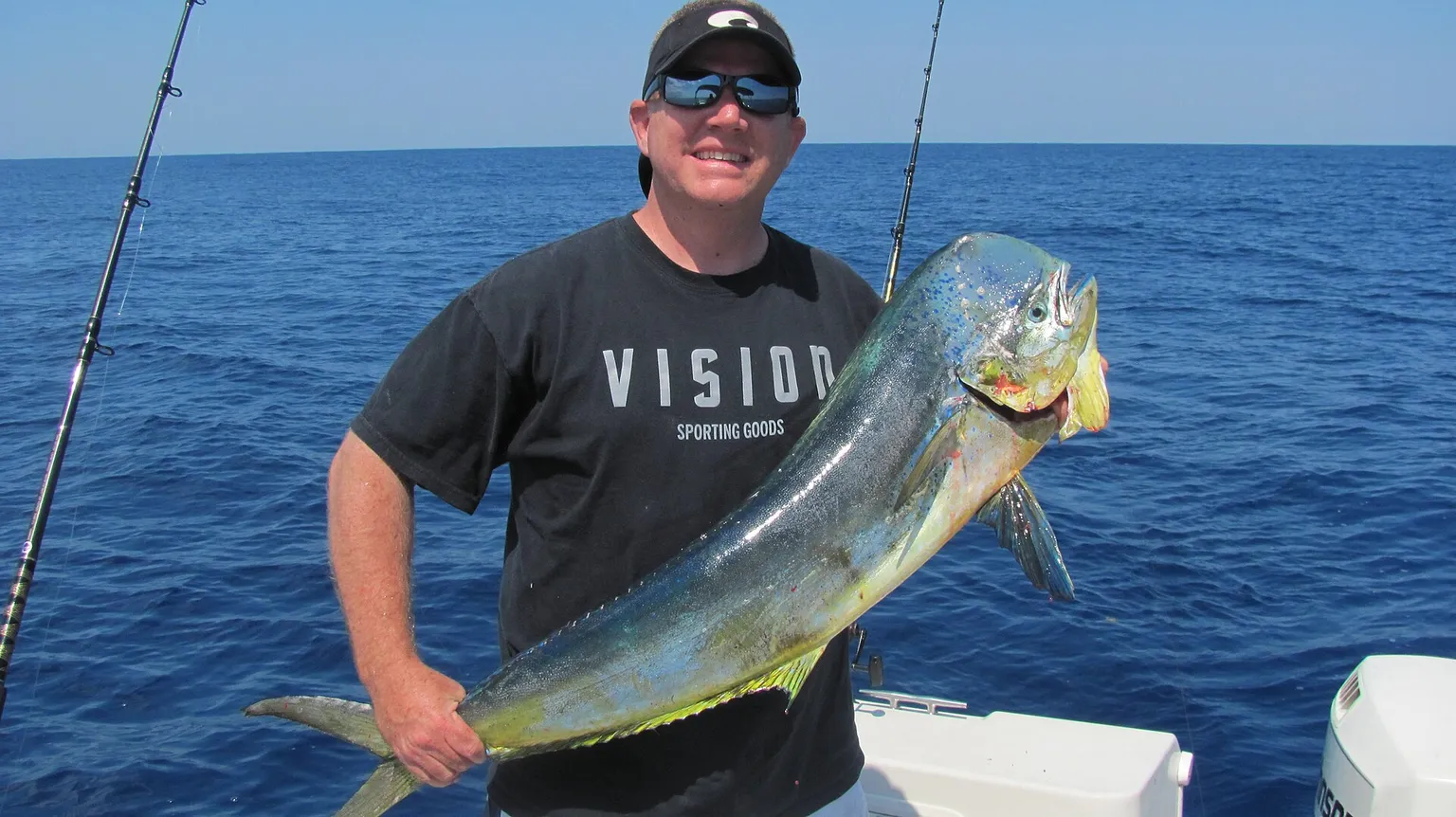
A mahi mahi can reproduce at four to five months old and will be dead of old age by five years. NOAA Fisheries gives both figures.
Nothing else about the species makes sense until you have those two numbers, so start there.
A fish living on a different clock
Most gamefish this site covers are slow projects. A red drum lives past 40 years. A wels catfish takes a decade to get interesting. A mahi mahi is the opposite in every respect.
| Lifespan | Up to 5 years |
| Capable of reproducing | 4 to 5 months old |
| Spawning frequency | Believed to spawn every 2 to 3 days in season |
| Eggs per spawning | Roughly 33,000 to 66,000 |
| Maximum size | Almost 7 feet and 88 pounds |
Read the middle row again. Every two to three days, through the season, at tens of thousands of eggs a time.
That is a species built to flood the ocean with offspring and accept enormous losses, and it has two consequences an angler feels directly.
The stock cannot be assessed the usual way
NOAA states plainly that the population level of the South Atlantic stock is unknown, but management measures are in place, and that overfishing status is likewise unknown.
That is not negligence. A conventional assessment counts year classes, and a fish that turns over this fast, migrates this widely and swings with the environment does not hold still long enough to be counted. NOAA's own explanation names the short life span, the highly migratory behaviour, the broad distribution and environmentally driven abundance as the reasons.
A bad season is not a crash
Because productivity is largely environmental rather than fishing-driven, abundance is sporadic from year to year. Two seasons in the same water can look like two different fisheries.
So treat a poor year as weather, not as evidence of collapse — and treat a brilliant one the same way. Neither tells you much.
The weed line is the whole technique
Here is the part that changes how you fish.
NOAA places mahi near the surface in tropical and subtropical waters, with females and smaller males often gathering near floating objects, including Sargassum — the floating brown algae they also spawn beneath.
So you do not look for fish. You look for structure that floats.
- Weed lines — long drifting rafts of Sargassum, often with a visible colour or current edge alongside them
- Single clumps, if they are big enough to hold bait
- Floating debris — a pallet, a log, a lost buoy
- Colour and temperature changes, which are where weed and bait accumulate in the first place
The logic is one step removed: floating structure holds small bait, bait holds mahi. A day spent running between pieces of floating structure beats a day spent running in a straight line.
Our live conditions tool shows current water temperature at the nearest NOAA station, which is the other half of finding an edge.
Fish the school, not the first fish
Juveniles school, and that is exploitable. The standard approach on a schooling fish is to keep one hooked fish in the water beside the boat — the rest of the school tends to stay with it — and cast to the others while it is there.
The big bulls are the ones found alone. NOAA notes larger males usually stay in open ocean rather than at the weed.
What to throw
Mahi are a top predator feeding near the surface during the day, and NOAA's prey list is almost comically broad: small pelagic fish, juvenile tuna, invertebrates, billfish, jacks, pompano, and the larvae of nearshore bottom-dwelling species.
In practice they are not fussy, and the method follows the situation rather than the fish:
- Trolling skirted lures or rigged ballyhoo to find the weed line in the first place
- Casting bait or soft plastics once you are on a school
- Fly, which works here far more readily than it has any right to
Braid with a fluorocarbon leader is the normal rig. Mahi do not have bluefish teeth, so wire is not needed — but they jump, repeatedly and violently, so a leader that survives abrasion against the fish and the boat earns its place.
The rules
There is a minimum size limit off Georgia, Florida and South Carolina, with recreational bag limits, under the South Atlantic Dolphin and Wahoo fishery management plan. Commercial trip limits and annual catch limits apply as well, and separate annual catch limits cover federal waters around Puerto Rico, St Croix and St Thomas/St John.
NOAA does not publish the specific figures on its species page, and we are not going to guess at them. Take the current numbers from your state agency or from the South Atlantic Fishery Management Council before you fish — they change, and the agency is the authority.
That caveat matters more here than for most species, because a short-lived fish gets its management adjusted more often.
A note on the name
Mahi mahi, dolphinfish and dorado are the same fish, Coryphaena hippurus. The "dolphinfish" name causes genuine confusion with the marine mammal, which is why restaurants and increasingly agencies use the Hawaiian mahi mahi instead. It is not a dolphin and is not related to one.
Related
- Mahi mahi — identification, range and diet
- Florida Keys — reef and bluewater within one trip
- The Florida Keys grand slam — three fish, three rulebooks
- Top 5 fluorocarbon leaders
- Live fishing conditions — water temperature, for finding an edge
Sources
- Atlantic Mahi Mahi — NOAA Fisheries — that they grow up to almost 7 feet and 88 pounds, live up to 5 years and are capable of reproducing at 4 to 5 months old; that they are believed to spawn every 2 to 3 days during the spawning season, releasing roughly 33,000 to 66,000 eggs each time, beneath floating brown algae called Sargassum; that they live near the surface in tropical and subtropical waters, with juveniles schooling, larger males usually staying in open ocean and females and smaller males gathering near floating objects including Sargassum; the prey list of small pelagic fish, juvenile tuna, invertebrates, billfish, jacks, pompano and larvae of nearshore bottom-dwelling species; predators including large tuna, marine mammals, marlin, sailfish and swordfish; that the population level of the South Atlantic stock is unknown and overfishing status is unknown, with management measures in place; that a traditional stock assessment is difficult owing to the short life span, highly migratory behaviour, broad geographic distribution and environmentally driven abundance; and management under the South Atlantic Dolphin and Wahoo fishery management plan including a minimum size limit off Georgia, Florida and South Carolina, recreational bag limits, commercial trip limits and annual catch limits.
Frequently asked questions
- How do you find mahi mahi?
- You look for structure on the surface rather than for the fish. NOAA notes that females and smaller males often gather near floating objects, including Sargassum — the floating brown algae they also spawn beneath. A weed line, a log, a buoy or any debris holds bait, and bait holds mahi. Running from one piece of floating structure to the next beats running in a straight line.
- How fast do mahi mahi grow?
- Extraordinarily fast. NOAA states they are capable of reproducing at 4 to 5 months old and live up to 5 years, reaching almost 7 feet and 88 pounds at the maximum. A fish that breeds before its first birthday and dies of old age at five is living on a completely different clock from most gamefish.
- Why is mahi mahi abundance so unpredictable?
- Because the population turns over almost completely every few years and is driven mostly by environment rather than by fishing. NOAA says productivity is thought to be largely environmentally driven, so abundance and availability is sporadic from year to year. A poor season does not mean the stock collapsed, and a brilliant one does not mean it is safe.
- Is there a stock assessment for mahi mahi?
- Not a conventional one. NOAA states the population level of the South Atlantic stock is unknown, but management measures are in place, and that a traditional assessment is difficult because of the species' short life span, highly migratory behaviour, broad distribution and environmentally driven abundance. Overfishing status is likewise listed as unknown.
- What is the size limit for mahi mahi?
- There is a minimum size limit off Georgia, Florida and South Carolina, plus recreational bag limits, under the South Atlantic Dolphin and Wahoo fishery management plan. NOAA does not publish the figures on its species page, and they change, so take them from your state agency or the South Atlantic Fishery Management Council before you fish.
- What do mahi mahi eat?
- Almost anything near the surface. NOAA lists small pelagic fish, juvenile tuna, invertebrates, billfish, jacks, pompano, and the larvae of nearshore bottom-dwelling species. They are a top predator that feeds near the surface during the day, which is why they will take a trolled lure, a cast bait and a fly on the same trip.
- Do mahi mahi school?
- The small ones do. NOAA describes juveniles swimming together in schools, with larger males usually staying in open ocean while females and smaller males gather near floating objects. In practice that means a weed line often produces numbers of modest fish, and the big bulls are the ones found alone.
- What eats mahi mahi?
- Large tuna, marine mammals, marlin, sailfish and swordfish, per NOAA. Being eaten by billfish while also eating billfish larvae is a fair summary of where mahi sit in the food web.