Bluegill
Lepomis macrochirus · Centrarchidae
Also known as: Bream, Brim, Sunfish, Coppernose
The most widely distributed panfish in North America, and a colonial nester whose beds are the most reliably findable spawning structure of any freshwater gamefish.
- Typical size
- 15–23 cm (6–9 in), 100–250 g
- Max size
- Exceptional fish exceed 30 cm (12 in) and 1 kg (2 lb).
- Water
- Freshwater
- Best season
- Late spring through summer; the spawn peaks in June across most of the Midwest.
Identification
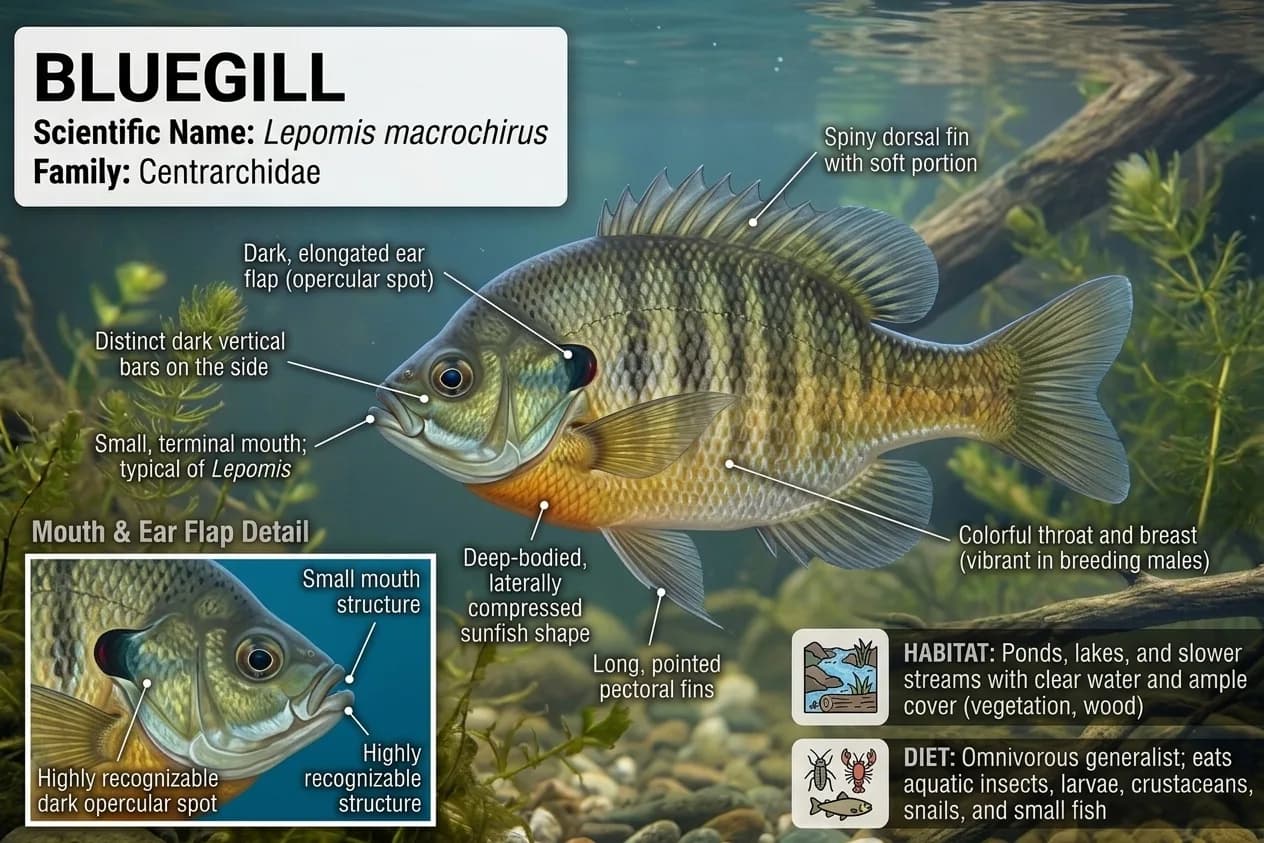
Deep, laterally compressed body; a solid dark opercular flap with no red or orange margin, which separates it from pumpkinseed and redear; vertical bars on the flank; a very small mouth; and a dark blotch at the rear of the soft dorsal fin.
Habitat & Range
Warm, weedy lakes, ponds, backwaters and slow river reaches. Spawning colonies favour sand and gravel in sheltered littoral areas, often beside emergent vegetation.
Native to eastern and central North America; introduced across nearly every US state and on several other continents.
Diet & Feeding
Aquatic insects — especially midge larvae and mayfly nymphs — plus small crustaceans, snails and zooplankton; larger fish take minnows and fry.
Spawning & Reproduction
A late-spring and summer colonial nester. Males fan saucer-shaped nests in shallow sand or gravel and guard them aggressively. Bluegill do not spawn once: they spawn in repeated bouts across a season that can run from late May into early August.
Spawning windowSource-verified
- Run begins
- May 20
- Peak
- Jun 15
- Ends
- Aug 9
- Redd temperature
- 70–80°F
Two thresholds, not one. Fish move shallow and males begin excavating nests at about 64°F, but Beard (1982) found actual egg deposition did not occur below 70°F and was rare above 80°F. Bluegill spawn in 4–11 discrete bouts per season, over seasons ranging 31–112 days — which is why beds keep reappearing all summer. Window dates are the observed Michigan onset (18 May) and cessation (9 August) from Beyerle and Williams (1967).
Timing is modelled for a mid-latitude reference population — fish the thermometer, not the calendar. Based on 3 cited sources.
Spawning timing by location
Spawning tracks water temperature, so the calendar shifts with latitude and elevation. These break bluegill timing down by state and water body.
- When Do Bluegill Spawn in Illinois?
Illinois bluegill spawn from May through August, peaking in June. The wrinkle unique to Illinois: in stunted populations the peak arrives three to four weeks later — so two neighbouring lakes can be a month apart.
- When Do Bluegill Spawn in Michigan?
Michigan bluegill spawn from mid-May into early August, peaking in June. A four-lake Michigan study tracked activity from May 18 until it stopped on August 9 — nearly three months, in repeated waves.
- When Do Bluegill Spawn in Wisconsin?
Wisconsin bluegill spawn from late May through early August, peaking in June. But they don't spawn once — they spawn in 4 to 11 separate bouts, which is why the beds keep coming back all summer.
How to Catch
Find the beds and you have found the fish — colonies are reused year after year, so a bed located one June is worth checking the next. In clear water look deeper than you expect, and deeper as the season goes on; in stained water stay shallow and fish under overhanging cover.
Best techniques
- Float fishing
- Light jigging
- Fly fishing (poppers, wet flies)
- Bank fishing
Lures & baits
- Redworms
- Crickets
- 1/32 oz jigs
- Small poppers
- Wax worms
Best season: Late spring through summer; the spawn peaks in June across most of the Midwest.