When Do Bluegill Spawn in Michigan?
Michigan bluegill spawn from mid-May into early August, peaking in June. A four-lake Michigan study tracked activity from May 18 until it stopped on August 9 — nearly three months, in repeated waves.
Published
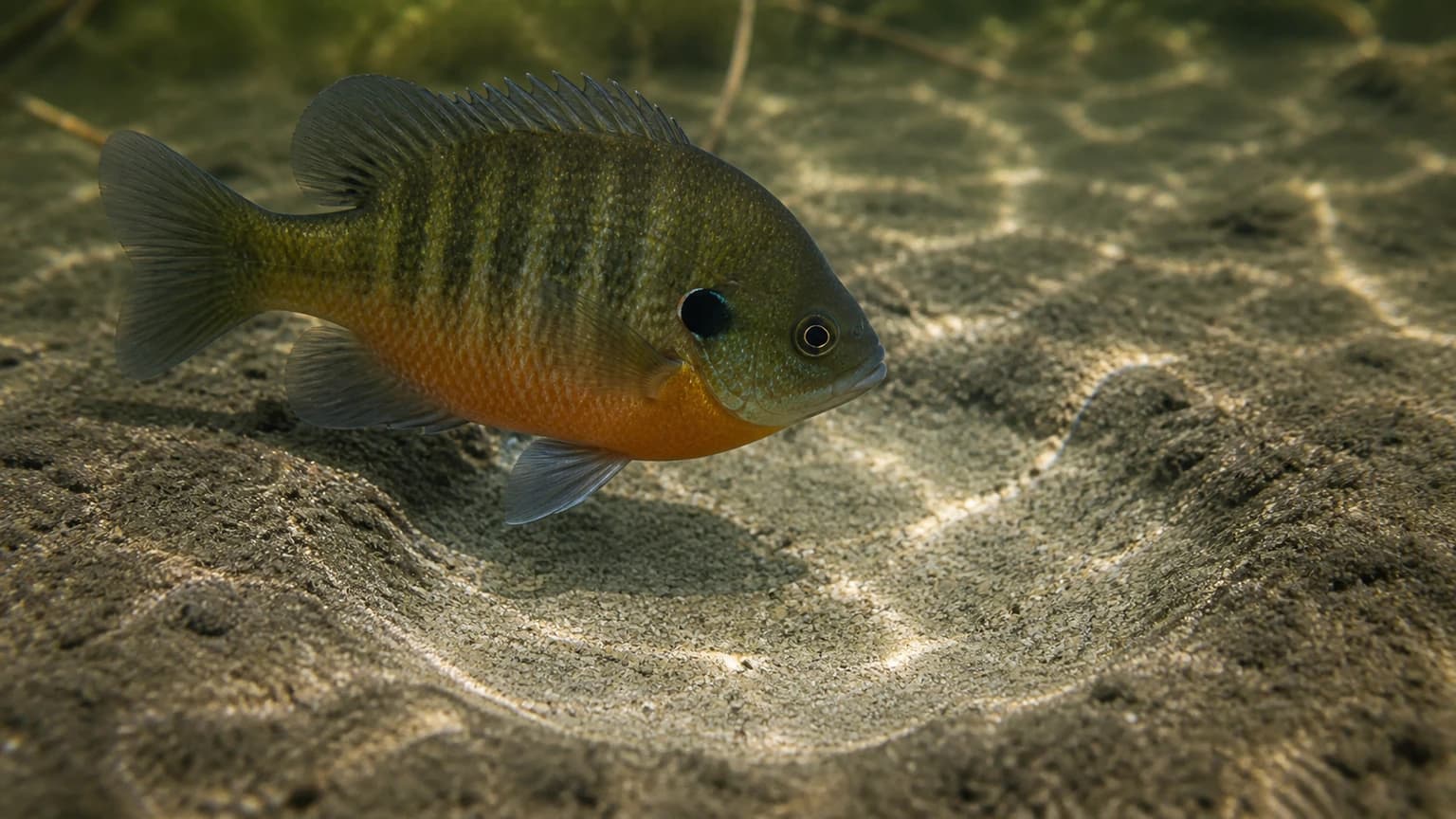
Michigan bluegill spawn from mid-May into early August, peaking in June. Michigan DNR puts the shallow-water move at 65°F, but the eggs do not go in until about 70°F — and the fish spawn in repeated waves, not once.
The observed dates, not an estimate
Most timing advice for Michigan bluegill is someone's recollection. There is a better source: a Michigan study that tracked nest sites across four lakes of 80 to 200 acres and recorded the spawn from the onset of spawning activity on 18 May until all spawning activity ceased on 9 August.
That is a start date and an end date, observed in the field, in Michigan lakes. Nearly three months.
It also tells you something the calendar version hides — the "spawn" is not a weekend. Bluegill spawn in 4 to 11 discrete bouts across a season, so the beds empty and refill repeatedly. If you found fish bedding in late May and nothing in mid-June, you hit a gap between waves.
65°F or 70°F? Both, and the difference is useful
Michigan DNR describes bluegill as spawning in the shallows when water reaches 65°F. Field research draws a sharper line:
| What's happening | Water temperature |
|---|---|
| Fish move shallow; males start fanning nests | ~64–65°F |
| Eggs actually go in the gravel | 70°F and above |
| Spawning becomes rare above | 80°F |
A Wisconsin DNR study that watched beds directly found no actual spawning below 70°F. So the DNR's 65°F is the right number for when to go looking — it is when fish arrive in the shallows and nests appear — and 70°F is when they are actually spawning.
For an angler that gap is an advantage, not a technicality. At 65°F the big parental males are shallow, holding on fresh nests, and nobody has fished them yet.
Timing by region
| Region | Beds appear | Peak |
|---|---|---|
| Southern Lower Peninsula | Mid-to-late May | Early-to-mid June |
| Northern Lower Peninsula | Late May to early June | Mid-to-late June |
| Upper Peninsula | Early June | Late June |
This table is modelled, not measured. It applies the 70°F egg-deposition threshold to Michigan's normal spring warming, anchored on the 18 May – 9 August window observed in the four-lake study. Lake size and depth matter as much as latitude: a shallow, dark-bottomed 40-acre lake in the north can bed before a big clear lake further south.
Why a cold spring costs you more than a late spawn
There is a striking piece of Michigan evidence for how tightly this is temperature-driven.
After the 1991 eruption of Mount Pinatubo cooled global temperatures, degree-days above 65°F in southern Michigan fell to 58% of normal in the summer of 1992. Researchers subsequently documented very weak 1992 bluegill year classes in 10 of 16 study lakes.
One cool summer, and more than half the studied lakes produced a failed cohort. It is the clearest illustration available that bluegill spawning is governed by accumulated warmth, not by the date.
Practically: in a cold, late spring do not just push your calendar back a week. Expect a compressed season with fewer bouts, and expect the fish to be concentrated when they do go.
Finding the beds
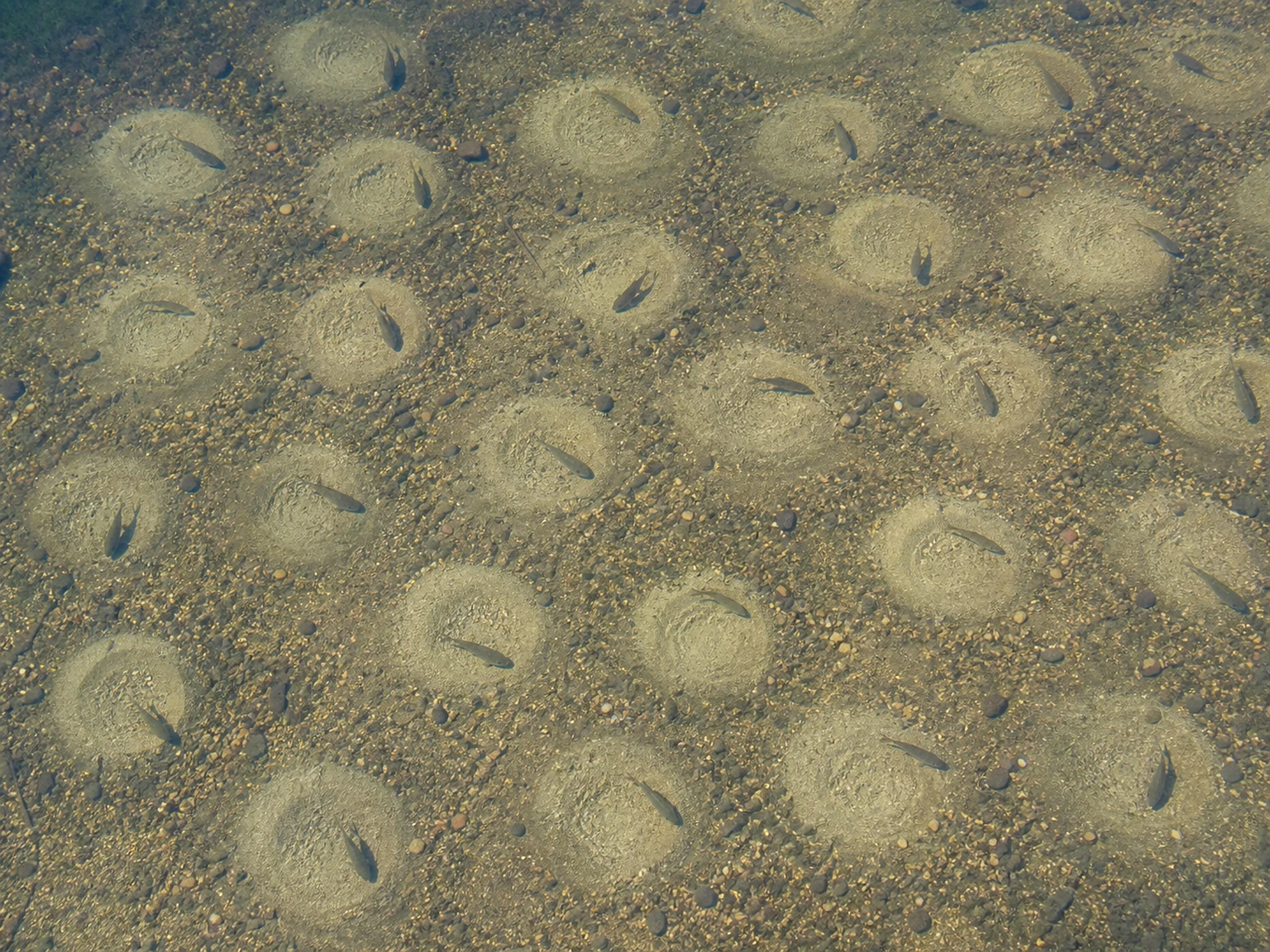
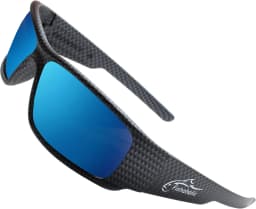
Michigan bluegill nest colonially — dozens of saucer-shaped depressions packed together, typically in 1 to 4 feet of water over sand or gravel, and often plainly visible from shore as pale circles on a darker bottom. Polarised glasses turn this from hard into trivial.
Two refinements worth having:
- Colonies are reused across years. A bed you find this June is a starting point next June. Mark them.
- In clear lakes, look deeper — and deeper as summer goes on. Nest depth increases through the season; in very clear water, colonies have been recorded well past 13 feet. Shallow-nesting fish in clear water site their beds under overhanging trees and docks to get out of the light, so fish the shade.
Substrate preference is sand, gravel or firm muck, with a slight edge to gravel mixed with sticks. Protected bays and the lee shore warm first — start there.
How to fish it
Pre-spawn (mid-60s°F). The size window. Work the outside of the colony with a 1/32 oz jig under a float, or swim the jig past the bed. The largest, darkest fish on the colony edge are the mature parental males.
Spawn (70–80°F). Fish are locked on and will hit almost anything entering the nest. A redworm or cricket under a slip float, or a small popper on a fly rod, is plenty.
Between bouts. When a bed goes quiet, move 20 yards out and down a few feet to the nearest weed edge or drop rather than leaving the lake. The next wave stages there.
Fishing over the beds
A guarding male will not leave his nest, which makes bedding bluegill the easiest fish in Michigan to catch and the easiest population to damage. Those big males took years to get that size, and their guarding is what keeps the eggs and fry alive.
Keep a meal if you want one. Emptying a colony is a different act, and it shows up in that lake's average size for years afterwards — recovery of size structure in an overexploited population has been estimated at 6 to 8 years even under tighter rules.
Check the Michigan DNR Fishing Guide for current panfish regulations on the water you are fishing.
Related
- Bluegill species profile — identification, range, and the verified spawning window.
- When do bluegill spawn in Wisconsin? — the observed 4-to-11-bout season, and how clarity sets bed depth.
- Seasonal fishing and verified spawning temperatures
Sources
- Bluegill — Michigan DNR — spawning in the shallows from 65°F, late spring to early summer.
- Bluegill Literature Review — Wisconsin DNR (PDF) — the review synthesising the studies below.
- Beyerle, G. B., and J. E. Williams. 1967 — four Michigan lakes of 80–200 acres; spawning activity from 18 May to 9 August.
- Schneider, J. C., and R. N. Lockwood. 2002 — very weak 1992 bluegill year classes in 10 of 16 southern Michigan lakes, following a drop in degree-days above 65°F to 58% of normal.
- Beard, T. D. 1982. Population dynamics of young-of-the-year bluegill. Wisconsin DNR Technical Bulletin 127 — the 70°F egg-deposition threshold and the 4–11 bouts per season.
- Olson, M. H., et al. 2008. Patterns of ultraviolet radiation exposure in bluegill nests over the course of the spawning season. Transactions of the American Fisheries Society 137:1446–1454.
- Beard, T. D., Jr., and T. E. Essington. 2000. Effects of angling and life history processes on bluegill size structure. Transactions of the American Fisheries Society 129:561–568.
The regional timing table is modelled: it applies the 70°F egg-deposition threshold to Michigan's normal spring warming pattern, anchored on the 18 May – 9 August window observed by Beyerle and Williams. Confirm with a thermometer before planning a trip.
Frequently asked questions
- When do bluegill spawn in Michigan?
- From mid-May into early August, peaking in June. A Michigan study of four lakes recorded spawning activity beginning on 18 May and ceasing on 9 August. Southern Lower Peninsula waters start first; Upper Peninsula lakes can run two to three weeks behind.
- What water temperature do bluegill spawn at in Michigan?
- Michigan DNR gives 65°F as the point bluegill move into the shallows to spawn. Field research draws a finer line: nests get fanned from about 64°F, but actual egg deposition was not observed below 70°F and became rare above 80°F. Beds in the mid-60s are being built, not used.
- How long does the bluegill spawn last in Michigan?
- Far longer than most anglers expect. The observed Michigan window ran from 18 May to 9 August — close to three months — because bluegill spawn in 4 to 11 separate bouts rather than one event.
- How deep are bluegill nests in Michigan?
- Typically 1 to 4 feet over sand or gravel, and often visible from shore as pale circles. Clear lakes are the exception: nests get deeper as the season warms, and in very clear water colonies have been recorded past 13 feet.
- Does a cold spring delay the bluegill spawn in Michigan?
- Yes, and it can affect the whole year class. After the 1991 Mount Pinatubo eruption cut degree-days above 65°F in southern Michigan to 58 percent of normal, researchers documented very weak bluegill year classes in 10 of 16 study lakes.
Gear for this
 AccessoriesCheck price on Amazon
Stream & Lake Water Thermometer
The one piece of kit every spawn article on this site tells you to carry.
- Check price on Amazon
- Check price on Amazon

- Check price on Amazon
ChronicAnglers is reader-supported. When you buy through links on our site, we may earn an affiliate commission at no extra cost to you.
Explore related
- SpeciesBluegillIdentification, range, diet, and verified spawning window.
- IllinoisWhen Do Bluegill Spawn in Illinois?
- WisconsinWhen Do Bluegill Spawn in Wisconsin?
- Also in MichiganWhen Do Brook Trout Spawn in Michigan?
- Also in MichiganWhen Do Crappie Spawn in Michigan?
- Also in MichiganWhen Do Steelhead Spawn in Michigan?
- Also in MichiganWhen Do Walleye Spawn in Michigan?
- Also in MichiganWhen Do Brown Trout Spawn in Michigan?