When Do Bluegill Spawn in Illinois?
Illinois bluegill spawn from May through August, peaking in June. The wrinkle unique to Illinois: in stunted populations the peak arrives three to four weeks later — so two neighbouring lakes can be a month apart.
Published
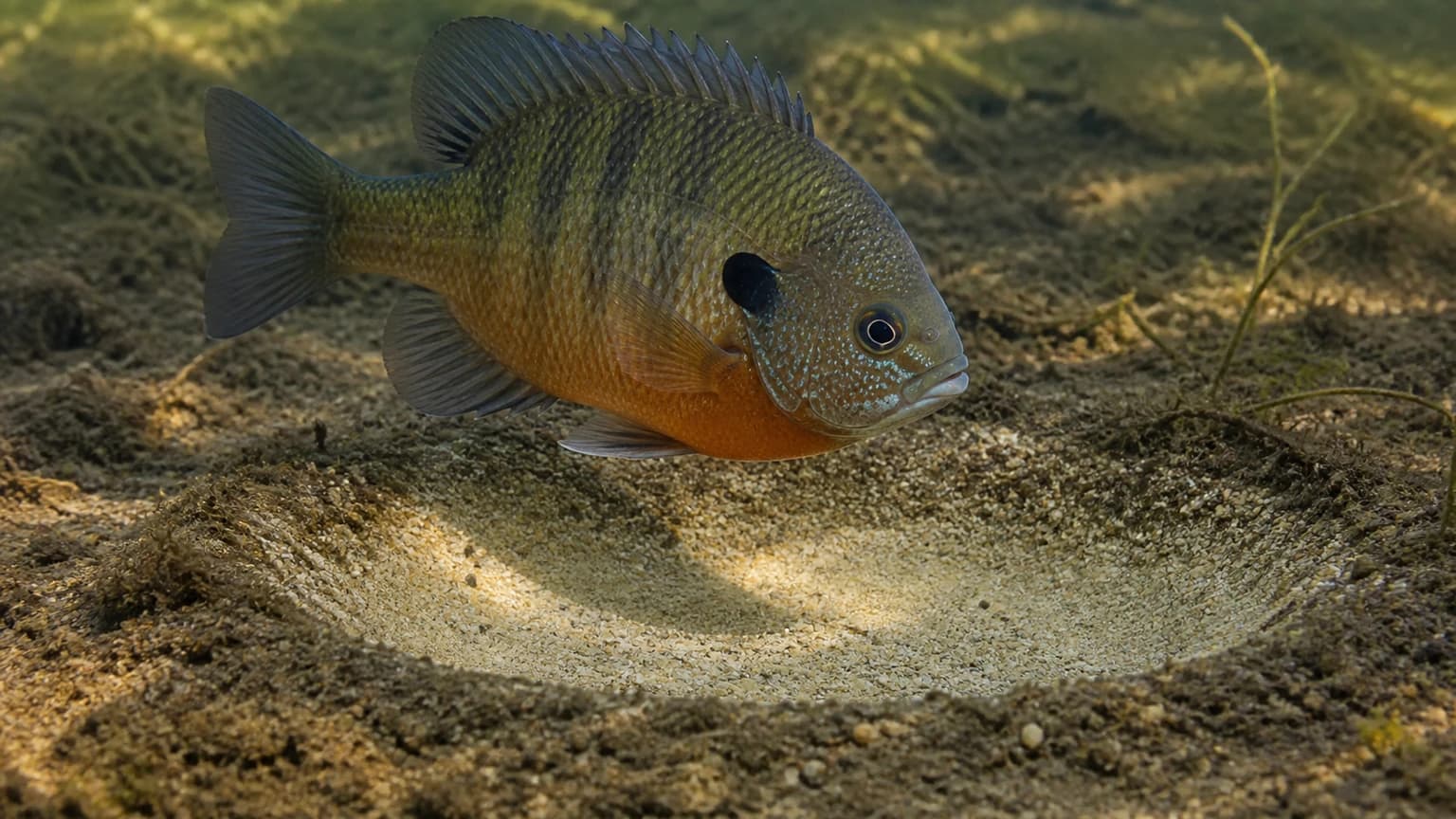
Illinois bluegill spawn from May through August, peaking in June, according to Illinois DNR. Nests get fanned from about 64°F, but the eggs do not go in until roughly 70°F — and the fish spawn in repeated waves rather than once.
The Illinois-specific wrinkle: stunted lakes bed weeks later
Here is something no general bluegill guide will tell you, and it comes from research done in Illinois ponds.
In stunted bluegill populations, peak spawning occurred three to four weeks later than in non-stunted populations. The comparison was clean: stunted populations where every nesting male was under 6.3 inches, against populations where nesting males exceeded 7.1 inches.
Three to four weeks. That is the difference between "the first week of June" and "the Fourth of July" — in the same state, in the same weather.
So if you fish a lake known for endless small bluegill and a lake known for slabs, do not assume they run on the same schedule. The stunted water will be behind. This one fact explains most of the disagreement you will find in Illinois fishing forums about when the spawn "really" happens.
The two temperatures
| What's happening | Water temperature |
|---|---|
| Fish move shallow; males start fanning nests | ~64°F |
| Eggs actually go in the gravel | 70°F and above |
| Spawning becomes rare above | 80°F |
The commonly repeated "bluegill spawn at 65°F" describes the arrival, not the act. A study that observed beds directly found no actual spawning below 70°F.
Treat the mid-60s as your cue to start looking. Treat 70°F as the spawn.
Timing across the state
Illinois runs roughly 385 miles north to south, which is a real spread in spring warming.
| Region | Beds appear | Peak |
|---|---|---|
| Southern Illinois | Late April to early May | Mid-to-late May |
| Central Illinois | Mid-May | Early-to-mid June |
| Northern Illinois | Late May | Mid-to-late June |
This table is modelled, not measured. Illinois DNR publishes the season as May through August without a per-region breakdown; the rows above apply the 70°F threshold to the state's normal north–south warming gradient. Water type moves it as much as latitude — small ponds and shallow strip pits warm well ahead of large reservoirs, and a stunted population will run later than either.
What the nest actually is
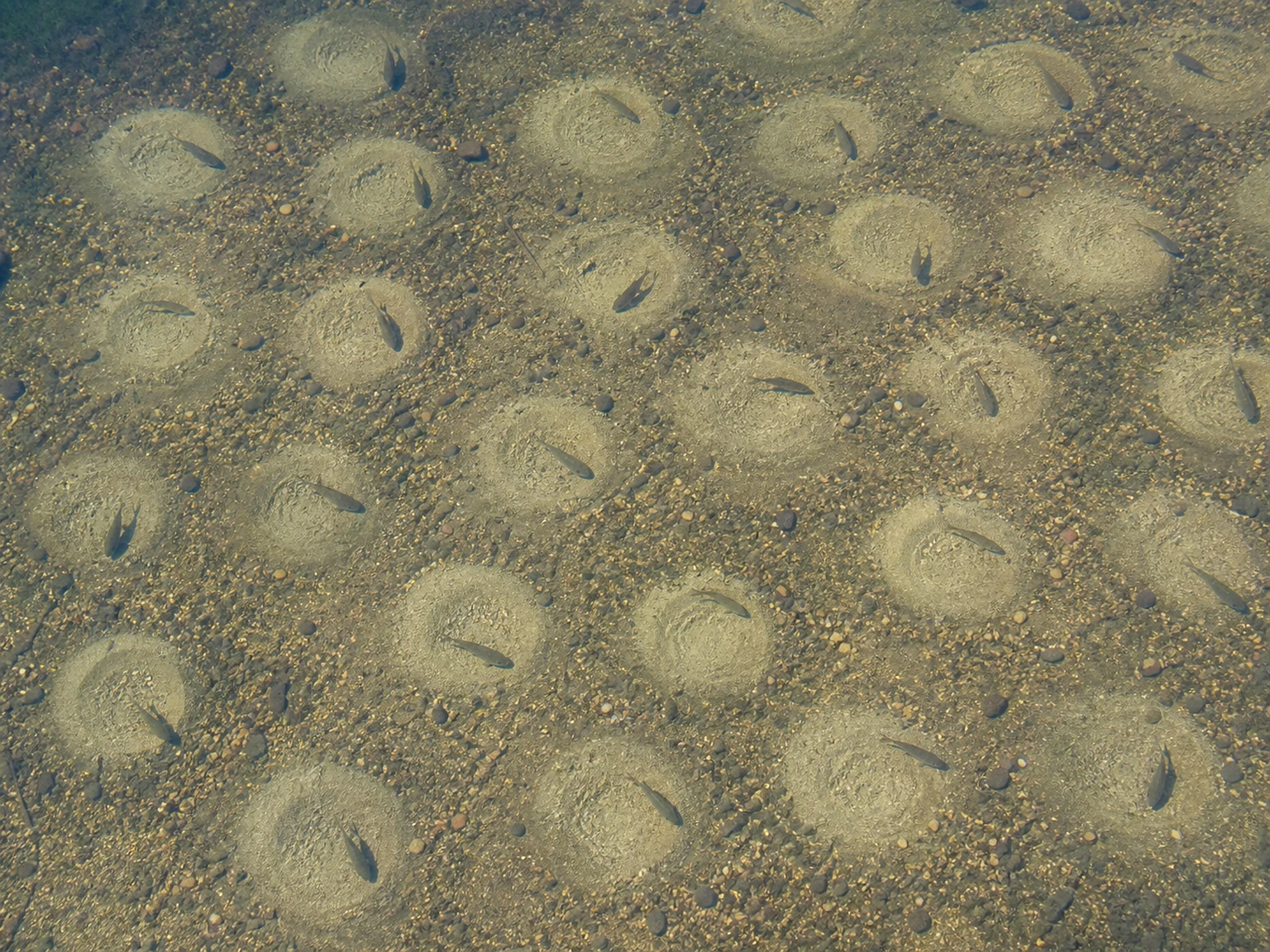
Bluegill nest colonially: dozens of saucer-shaped depressions packed together in shallow sand or gravel, usually visible from the bank as pale circles on a darker bottom. The male fans the nest clear with his fins, then guards it.
Illinois DNR fills in the reproductive detail: the female deposits 2,300 to 67,000 eggs, the male guards them, and they hatch in five to ten days. Several females may spawn in a single nest, and one female may spread her eggs across several — which is why a colony can produce far more fry than the nest count suggests.
Two practical notes:
- Colony sites are reused year after year. Mark the ones you find.
- In clear water, look deeper — and deeper as the season goes on. Nest depth increases through the season; in very clear lakes colonies have been recorded past 13 feet. In stained water, stay shallow and fish the shade under overhanging brush and docks.
Fishing the phases
Pre-spawn, mid-60s°F. The best window for size. Big parental males are shallow on fresh nests and unpressured. Work the outside edge of the colony with a 1/32 oz jig under a float.
Spawn, 70–80°F. Fish are locked on and defensive. A redworm or cricket under a slip float, or a small popper, is all you need.
Between bouts. When a bed goes quiet, drop to the nearest weed edge or breakline instead of leaving — the next wave stages there. In Illinois this matters more than most places, because heavy largemouth predation on littoral fry means the fish that spawn later often contribute more to the year class than the first wave does.
Keeping a lake good
A guarding male will not abandon his nest, which makes bedding bluegill trivially easy to catch and a colony easy to strip. Male parental care is a genuine driver of larval survival, not a detail.
Take a meal. Do not take the colony. Recovery of size structure in an overexploited population has been estimated at 6 to 8 years, even with tighter regulations — and in Illinois, where stunting is already the common failure mode, removing the large parental males is precisely the wrong lever.
Check the Illinois DNR fishing regulations for the water you are fishing.
Related
- Bluegill species profile — identification, range, and the verified spawning window.
- When do bluegill spawn in Wisconsin? — the 4-to-11-bout season, and how clarity sets bed depth.
- When do bluegill spawn in Michigan? — observed start and end dates from a four-lake study.
Sources
- Bluegill — Illinois DNR — spawning May through August; 2,300–67,000 eggs; hatching in five to ten days.
- Bluegill Literature Review — Wisconsin DNR (PDF) — the review synthesising the studies below.
- Aday, D. D., C. M. Cush, D. H. Wahl, and D. P. Philipp. 2002. The influence of stunted body size on the reproductive ecology of bluegill Lepomis macrochirus. Ecology of Freshwater Fish 11:190–195 — peak spawning three to four weeks later in stunted Illinois populations.
- Beard, T. D. 1982. Population dynamics of young-of-the-year bluegill. Wisconsin DNR Technical Bulletin 127 — the 70°F egg-deposition threshold, the 80°F upper bound, and the 4–11 bouts per season.
- Santucci, V. J., and D. H. Wahl. 2003 — Ridge Lake, east-central Illinois; young largemouth bass consumed 58–93% of littoral-zone bluegill fry, and early-season fry suffered higher mortality by fall than later ones.
- Olson, M. H., et al. 2008. Patterns of ultraviolet radiation exposure in bluegill nests over the course of the spawning season. Transactions of the American Fisheries Society 137:1446–1454.
- Beard, T. D., Jr., and T. E. Essington. 2000. Effects of angling and life history processes on bluegill size structure. Transactions of the American Fisheries Society 129:561–568.
The regional timing table is modelled: Illinois DNR publishes a statewide May–August season without a per-region split, so the rows above apply the 70°F egg-deposition threshold to the state's north–south warming gradient. Confirm with a thermometer before planning a trip.
Frequently asked questions
- When do bluegill spawn in Illinois?
- Illinois DNR gives the spawning season as May through August, with the peak in June. Southern Illinois waters can start in late April in a warm year; northern Illinois generally runs one to two weeks behind the centre of the state.
- What water temperature do bluegill spawn at in Illinois?
- Two thresholds. Males begin fanning nests at about 64°F, but field research found actual egg deposition did not occur below 70°F and became rare above 80°F. A bed found in the mid-60s is under construction rather than in use.
- Why do two nearby Illinois lakes spawn weeks apart?
- Stunted populations spawn later. Research in Illinois ponds found peak spawning in stunted bluegill populations — where nesting males were all under 6.3 inches — occurred three to four weeks later than in populations whose nesting males exceeded 7.1 inches.
- How many eggs do bluegill lay, and how fast do they hatch?
- Illinois DNR puts it at 2,300 to 67,000 eggs per female, with the male guarding the nest and the eggs hatching in five to ten days. Several females may use the same nest, and one female may spread eggs across several nests.
- How many times do bluegill spawn in a season?
- Between 4 and 11 separate bouts. That is why beds keep reappearing through the summer and why a season that looks finished in mid-June often is not.
Gear for this
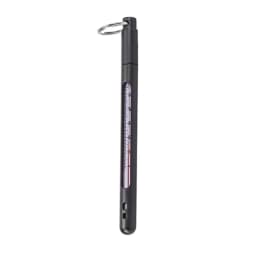 AccessoriesCheck price on Amazon
Stream & Lake Water Thermometer
The one piece of kit every spawn article on this site tells you to carry.
- Check price on Amazon
- Check price on Amazon

- Check price on Amazon
ChronicAnglers is reader-supported. When you buy through links on our site, we may earn an affiliate commission at no extra cost to you.