Smallmouth vs Largemouth Bass: How to Tell Them Apart
Colour is the first thing people reach for and the least reliable thing there is — a smallmouth from clear rock and a largemouth from a tannic pond can look like the same fish. The jaw settles it, two state agencies word it identically, and it works on a fish you have never seen before.
Published
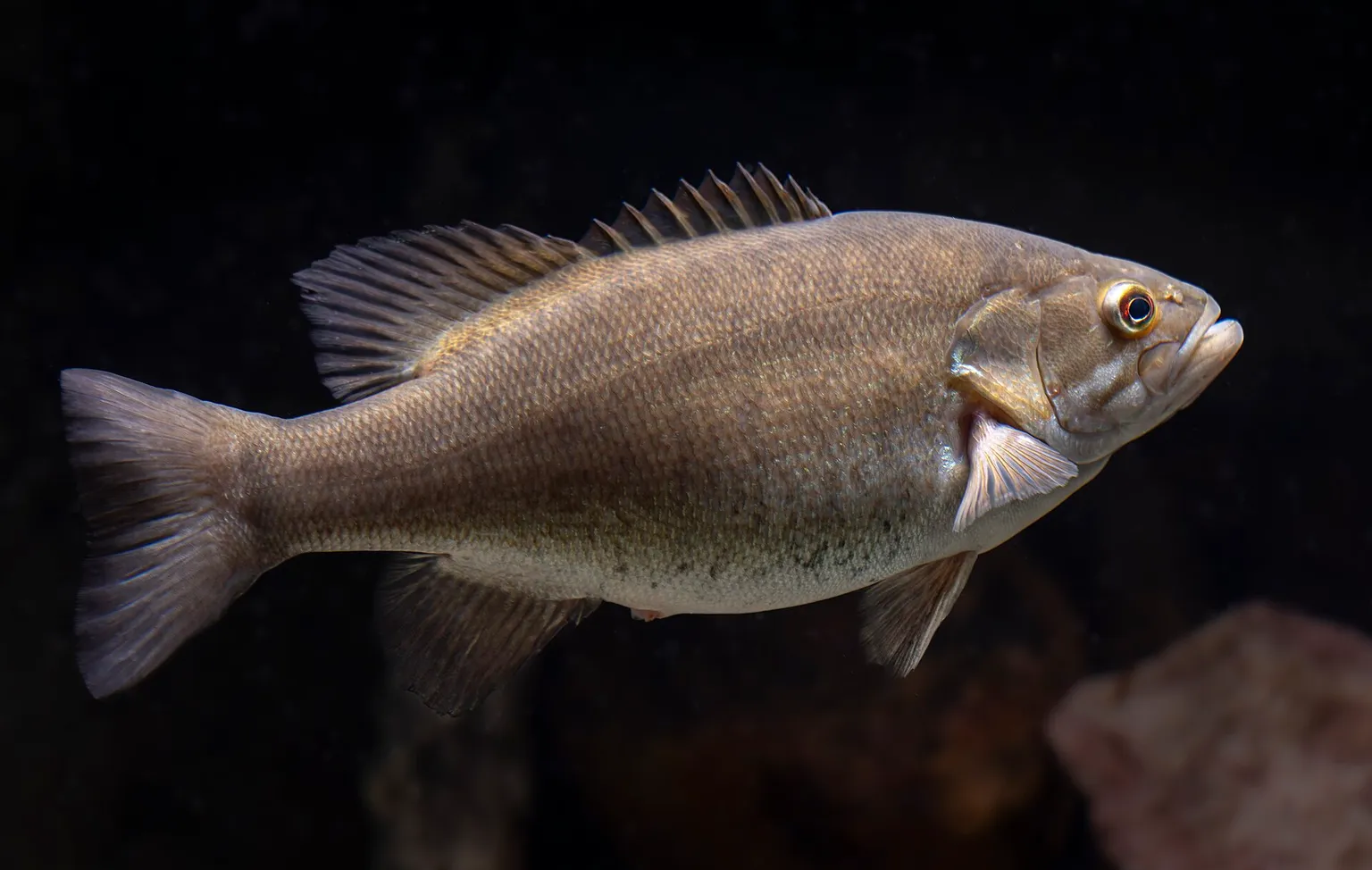
Close the fish's mouth and look at the eye. If the upper jaw ends behind the back edge of the eye, it is a largemouth. If it stops short of it, it is a smallmouth.
That is the whole test, it works on a fish you have never seen before, and it is the one two state agencies word almost identically.
The jaw test
Pennsylvania Fish and Boat Commission gives one line for each fish:
Largemouth: "the upper jaw extends beyond the back edge of its eye."
Smallmouth: "the upper jaw does not extend beyond the back edge of its eye."
Michigan's dichotomous key splits them on exactly the same feature. When two agencies independently use one characteristic as the branch point, that is the one to learn.
It works because it is structural, not cosmetic. A largemouth's jaw is built to engulf; a smallmouth's is built to grab. Everything else about these fish — the colour, the markings, the fight — follows from that difference and from where they live, but the jaw is the part that does not change with water, season or mood.
Why colour fools everybody
Colour is the first thing people reach for and the least reliable thing available.
Both species shift with water clarity, bottom type and stress. A largemouth out of tannic, stained water comes up dark and bronzy. A smallmouth over pale sand in bright sun comes up washed-out and greenish. Put those two side by side and the usual rules invert.
So use colour to form a guess, and the jaw to settle it.
| Smallmouth | Largemouth | |
|---|---|---|
| Upper jaw | Does not extend past the back of the eye | Extends beyond the back of the eye |
| Markings | Vertical, broken bars down the flank | A dark horizontal band along the flank |
| Typical colour | Brown or bronze back, white to pale-yellow belly | Bright-green to olive-green head and back |
| Body | Slimmer | "More rounded side to side", a little larger |
| Dorsal fin | Shallower notch (see caveat below) | Deeper notch, nearly two fins |
| Water | Streams and rivers with gravel, rocky areas, clear lakes | Weedy lakes and ponds, sluggish and backwater river stretches |
Smallmouth colour and markings are from Pennsylvania Fish and Boat; largemouth colour and body shape likewise. Checked 18 October 2026.
The dorsal fin caveat
You will see the dorsal fin given as a clean test. It is not quite one, and it is worth being straight about why.
Wisconsin DNR describes the largemouth's dorsal fin as almost divided into two separate sections. Michigan's material describes the smallmouth's spiny and soft-rayed portions as united. Those two statements point the same way — a largemouth has the deeper notch — but the agencies are describing different fish in different words, and on a living fish with the fin folded down it is a judgement call.
Use it to confirm, not to decide. The jaw decides.
Where each one lives, and why it matters more than ID
Here is the part that actually changes how you fish, and it is the more useful half of the distinction.
Smallmouth want current, rock and clarity. PA Fish and Boat places them in warm streams and rivers with gravel bottoms, rocky areas along weed beds, and a few clear lakes, ponds and reservoirs. Wisconsin DNR says the species is common in medium to large streams and in large, clearwater lakes, and is usually associated with a rocky stream or lake environment.
Largemouth want cover, weed and still water. PA Fish and Boat: weedy lakes and ponds, sluggish or backwater areas on rivers — and notes they can tolerate a wide range of conditions, which is why they are the bass most Americans actually have access to.
So on a river, the fish in the fast gravel run is probably a smallmouth and the fish in the slack backwater behind the log is probably a largemouth. You can often predict which one you have hooked before you see it.
What smallmouth eat, and what that means for your tackle box
Wisconsin DNR is unambiguous: crayfish are the smallmouth's favourite food. It also names hellgrammites and dragonfly larvae as effective natural baits, especially in early morning and late evening.
That single fact explains most of the smallmouth lure aisle:
- Brown, green and orange soft plastics — because that is what a crayfish looks like
- Football jigs with a craw trailer, dragged on hard bottom — the head shape exists specifically to be fished over the rock smallmouth live on
- Ned rigs on light line in clear water, which is close to unfair on pressured smallmouth
- Inline spinners in rivers, where flash and vibration cover water fast
Largemouth in weed want something that comes through it: a weedless spoon, a soft jerkbait on an EWG hook, or a square bill bounced off wood.
Clear water and light line also argue for a leader you can get away with — see our fluorocarbon guide.
Spawning
Both are nest builders, and both are vulnerable on the bed.
Wisconsin DNR gives smallmouth spawning at 62 to 64°F, noting they have been found spawning as low as 53°F, and running from mid-May through June in southern Wisconsin. The male builds several "practice nests" before settling on one — described as a large, perfectly circular, clean gravel structure — and then guards it against intruders of his own and other species.
That guarding behaviour is why a bedding smallmouth is easy to catch and why doing it is a choice with consequences: the male is the nest's only defence, and a nest left unguarded gets cleaned out. Our spawning calendar carries the verified windows for both species, and the ethics are covered in catch and release, done right.
Fish the thermometer, not the calendar. A water thermometer tells you more about whether the spawn has started than any date, and our live conditions tool shows current water temperature at the nearest NOAA station.
Related
- Smallmouth bass and largemouth bass — range, diet and verified spawning windows
- Spawning calendar — when, by temperature rather than date
- When do largemouth bass spawn in Missouri · in Ohio
- World record largemouth bass — the split record, and why it stands
- Northern pike identification — the same approach applied to the Esox family
Sources
- Bass — Pennsylvania Fish and Boat Commission — that on a smallmouth "the upper jaw does not extend beyond the back edge of its eye" and on a largemouth "the upper jaw extends beyond the back edge of its eye"; that the smallmouth "has vertical, broken bars along each side of the body" and "typically dons a brown or bronze color on its back with a white or pale-yellow belly"; that the largemouth "is more rounded side to side", is "a little bit larger in size" and that "Its head and back are bright-green to olive-green"; and the habitat descriptions for each, including that largemouth "can tolerate a wide range of conditions".
- Smallmouth bass — Wisconsin Department of Natural Resources — that the species "is common in medium to large streams and in large, clearwater lakes throughout Wisconsin" and is "usually associated with a rocky stream or lake environment"; that spawning "usually occurs at water temperatures between 62 - 64º F, but they have been found spawning at 53º F", running "from the middle of May through June" in southern Wisconsin; that the male "may build several 'practice nests' until he finally settles on one as suitable", that the nest is "usually a large, perfectly circular, clean gravel structure" and that the male "protects the nest against intruders of his own and other species"; and that crayfish are the species' "favorite food", with hellgrammites and dragonfly larvae as effective natural baits.
Frequently asked questions
- How do you tell a smallmouth from a largemouth bass?
- Close the fish's mouth and look at where the upper jaw ends relative to the eye. Pennsylvania Fish and Boat Commission puts it in one line for each: on a largemouth 'the upper jaw extends beyond the back edge of its eye', and on a smallmouth 'the upper jaw does not extend beyond the back edge of its eye'. That test works regardless of colour, size or water.
- Why is colour a bad way to identify bass?
- Because both species change colour with water clarity, bottom type and stress. A largemouth from tannic water can look dark bronze, and a smallmouth over pale sand can look green. The jaw does not change. Use colour as a first guess and the jaw to settle it.
- Do smallmouth have stripes or bars?
- Vertical bars. PA Fish and Boat describes the smallmouth as having 'vertical, broken bars along each side of the body', typically over a brown or bronze back with a white or pale-yellow belly — which is where the nickname bronzeback comes from. A largemouth instead shows a dark horizontal band running the length of the flank.
- Is the dorsal fin a reliable way to tell them apart?
- It is a supporting clue rather than a decider, because state agencies describe it differently. Wisconsin DNR describes the largemouth dorsal as almost divided into two sections, while Michigan's material describes the smallmouth's spiny and soft-rayed portions as united. The direction is consistent — deeper notch on a largemouth — but the jaw is the test to rely on.
- Do smallmouth and largemouth live in the same water?
- Sometimes, but they prefer different things, and that is the most useful practical difference. PA Fish and Boat puts smallmouth in warm streams and rivers with gravel bottoms, rocky areas along weed beds and a few clear lakes, and largemouth in weedy lakes and ponds and sluggish or backwater areas on rivers, adding that largemouth can tolerate a wide range of conditions.
- Which fights harder, smallmouth or largemouth?
- Smallmouth, by near-universal agreement among anglers, and the habitat explains it: a fish that lives in current is built differently from one that ambushes from weed. A largemouth of the same weight is usually the heavier fish and the smallmouth the faster, more acrobatic one.
- What do smallmouth bass eat?
- Crayfish above all. Wisconsin DNR calls crayfish the species' favourite food and names hellgrammites and dragonfly larvae as effective natural baits, especially early morning and late evening. That is why brown and green crayfish-imitating jigs and soft plastics are the smallmouth standard.
- When do smallmouth bass spawn?
- Wisconsin DNR gives spawning at water temperatures between 62 and 64°F, though they have been found spawning at 53°F, running mid-May through June in southern Wisconsin. The male builds several practice nests before settling on one, described as a large, perfectly circular, clean gravel structure, which he then guards.