When Do Brown Trout Spawn in Utah?
Utah brown trout peak in November — later than most of the Rockies. Elevation spreads the state's timing by weeks, and the Green River tailwater below Flaming Gorge runs on a schedule of its own.
Published
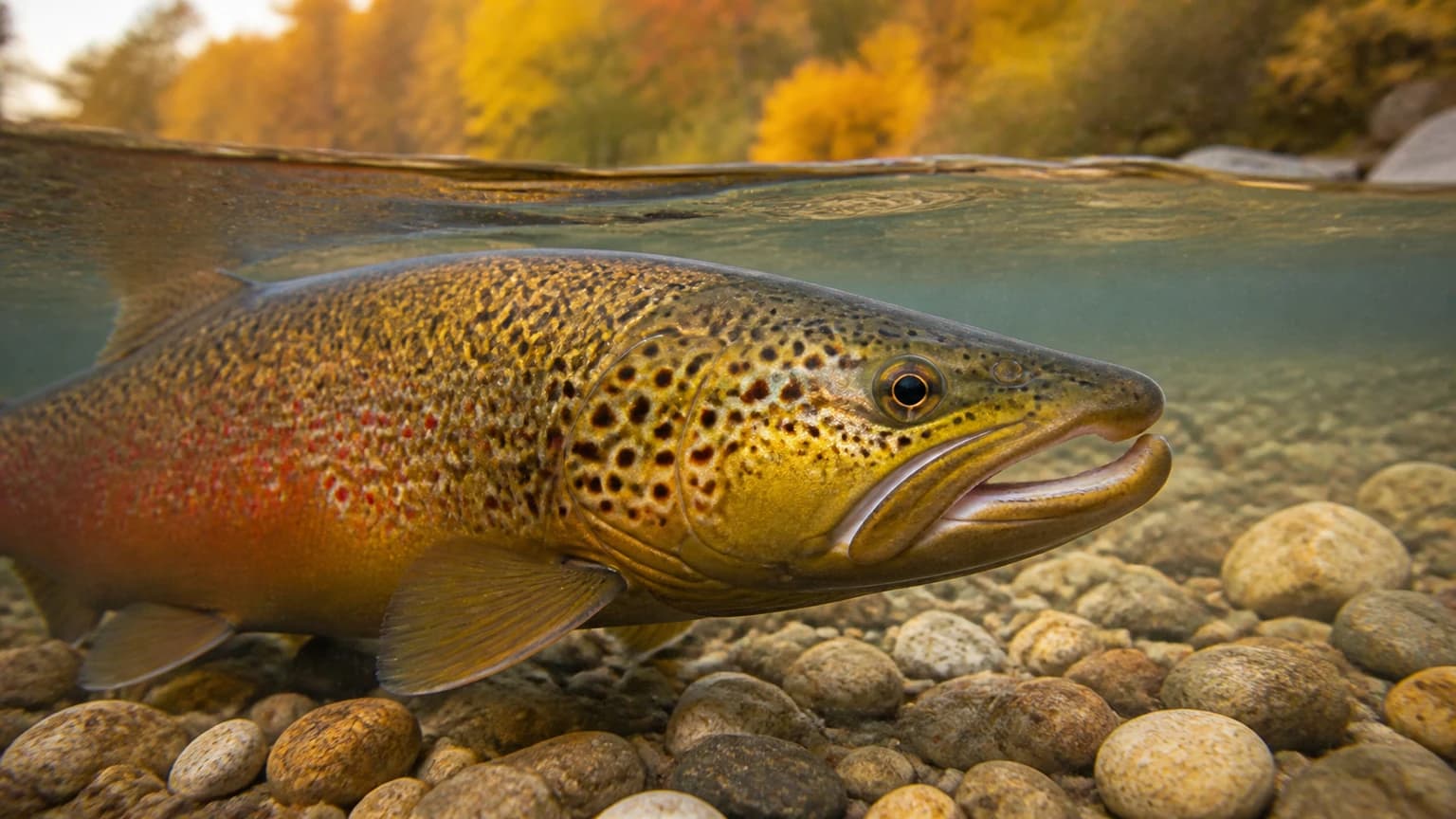
Utah brown trout spawn from October into December, peaking in November, when water falls into the 42–48°F band. Utah's Division of Wildlife Resources puts the peak squarely in November — later than most of the Rocky Mountain states.
Elevation splits Utah more than latitude does
Utah is not a big state north to south, but it has one of the largest usable elevation ranges in the country for trout water. The high Uintas hold fishable streams above 10,000 feet. The Green River below Flaming Gorge runs at roughly 5,500 feet in high desert.
That is a spread of nearly a mile, and it moves the spawn by weeks.
| Water type | Redds start | Peak |
|---|---|---|
| High Uinta streams and lakes (9,000 ft +) | Late September – early October | Mid-October |
| Mid-elevation freestone (6,500–9,000 ft) | Mid-October | Late October – early November |
| Lower freestone and valley rivers | Late October | November |
| Tailwaters (Green, Provo, Weber below dams) | Early-to-mid November | Mid-to-late November, into December |
This table is modelled, not measured. It applies the 42–48°F threshold to Utah's normal autumn cooling by elevation, and it is anchored on Utah DWR's identification of November as the statewide peak. Elevation is the variable — carry a thermometer and it will beat any calendar.
Why the tailwaters run last
This is the part that catches people out, and it is the most useful thing to understand about fishing Utah in the fall.
A freestone stream is fed by snowmelt, rain and shallow groundwater. Its temperature tracks the air, so when October nights turn cold it cools fast.
A tailwater is fed from the depths of a reservoir. Flaming Gorge releases water drawn from far below the surface, where temperature barely moves with the season. So the Green River cools slowly, holds warmer far longer than a freestone at the same elevation would, and reaches spawning temperature weeks later.
The practical version: when the high country has finished and the Uinta streams are locked up, the Green is only getting started. Utah's brown trout season effectively runs from early October through December if you follow the water types down.
That is also why the Green fishes so well in November — big fish paired up in shallow water, in a river that stays clear and cold and open all winter.
The run and the spawn are not the same thing
Fish start moving before they start spawning, and the gap is usually four to six weeks:
| Event | Water temperature |
|---|---|
| Fish begin migrating and pairing up | 45–50°F, falling |
| Redd construction and egg deposition | 42–48°F |
⚠️ A figure of 38–44°F circulates widely as the "peak spawning" range. It is uncorroborated, and it contradicts both the agency sources and the peer-reviewed redd surveys. Use 42–48°F.
Males develop a kype — a hooked lower jaw — through the spawning season, and colour up to deep bronze with black and red-orange spots ringed in pale halos. Unlike Pacific salmon, they survive and spawn again in later years.
Nothing is closed — which puts it on you
Utah's default is year-round fishing, and the Green River below Flaming Gorge is open through the spawn with no seasonal closure. A small number of waters — typically high-country tributaries holding native cutthroat — carry seasonal restrictions as exceptions in the Utah Fishing Guidebook. Check the specific water; the exceptions are what change year to year.
So on most Utah brown trout water there is no regulation stopping you fishing a redd. Which makes it an etiquette question, and on a river as heavily fished as the Green it is a live one.
How to identify a redd: a distinctly clean, pale oval of gravel — usually two to four feet across — standing out against darker, algae-stained streambed. Shallow, fast water, typically at the tail-out of a pool where current accelerates over gravel. Once you have seen one you will not miss another.
The convention: fish below the redds, not on them. Trout stacked downstream of spawning gravel are eating drifting eggs and are legitimate targets. The paired fish on the gravel are not. And do not wade across clean gravel — eggs sit in it until spring, and a wading boot ends that season's recruitment on that patch.
Brown trout are not native here
Utah's native trout is the Bonneville cutthroat. Brown trout are native to Europe, North Africa and western Asia and arrived in North America in the 1880s.
This matters beyond trivia. In drainages where the two overlap, brown trout compete with and prey on native cutthroat, and Utah DWR manages several waters specifically to protect cutthroat populations — which is exactly where you will find those seasonal closures. If you are fishing high tributaries in autumn, read the exceptions carefully.
How to fish each phase
Pre-spawn — the move (October). Fish are relocating and aggressive. Streamers, swung and stripped, larger than summer patterns. Overcast days and the hours after a cold front are the best of it.
Spawn (November). Egg patterns below the gravel. A single egg fly or a small egg-and-nymph dropper drifted through the run downstream of a redd is the whole game. Fish holding there are actively feeding.
Post-spawn (late November into winter). Spent fish are thin and hungry, and they drop back into deeper slower water. Small streamers and midge patterns fished slow. The Green in December is cold, clear, quiet and very good.
Related
- Brown trout species profile — identification, range, and the verified spawning window.
- When do brown trout spawn in Colorado? — the same elevation logic in a neighbouring state.
- When do brown trout spawn in Montana? — where closures do shut water during the spawn.
Sources
- Utah Division of Wildlife Resources — brown trout spawn — DWR states November is the peak of the brown trout spawn.
- Utah Fishing Guidebook — Utah DWR — year-round default and water-specific seasonal exceptions.
- Montana Field Guide — Brown Trout, Montana FWP — 42–48°F spawning threshold.
- Brown Trout Spawn Timing, Redd Locations, and Stream Characteristics in Spearfish Creek, South Dakota (2020) — redd survey: first redds 15 October, peak in the first week of November, none after 12 November; redd sites sit on slightly warmer groundwater upwelling with smaller substrate and higher velocity.
The elevation timing table is modelled from the 42–48°F spawning threshold applied to Utah's autumn cooling by elevation, anchored on Utah DWR's statewide November peak. Tailwater timing is driven by reservoir release temperature rather than air temperature. Confirm with a thermometer or USGS gauge before planning a trip.
Frequently asked questions
- When do brown trout spawn in Utah?
- October into December, with the peak in November — Utah's Division of Wildlife Resources identifies November as the peak of the brown trout spawn. Redd construction requires water at 42–48°F, so high Uinta streams run weeks ahead of desert tailwaters.
- What water temperature do brown trout spawn at?
- 42–48°F (6–9°C). Fish begin migrating as water falls through 45–50°F. The widely repeated 38–44°F figure is uncorroborated and contradicts the agency and peer-reviewed sources.
- Is the Green River closed during the brown trout spawn?
- No. The Green River below Flaming Gorge is open year-round, with no fall spawning closure. Utah's default is year-round fishing and only a small number of waters carry seasonal restrictions, so check the current Utah Fishing Guidebook for the specific water. Because there is no regulatory protection, redd etiquette is entirely on the angler.
- Why does the Green River spawn later than Utah's mountain streams?
- It is a tailwater. Water released from the depths of Flaming Gorge Reservoir stays at a far more stable temperature than a freestone stream, so it cools slowly through autumn and reaches the 42–48°F spawning band weeks after high-country water does.
- Are brown trout native to Utah?
- No. Brown trout are native to Europe, North Africa and western Asia, and were introduced to North America in the 1880s. Utah's native trout is the Bonneville cutthroat, and brown trout compete with and prey on native cutthroat in some drainages.
Gear for this
 AccessoriesCheck price on Amazon
Stream & Lake Water Thermometer
The one piece of kit every spawn article on this site tells you to carry.
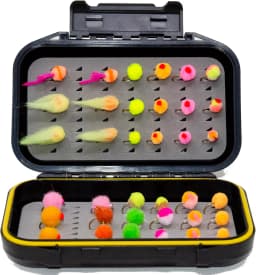 LuresCheck price on Amazon
Egg Patterns & Beads
The presentation every spawn article here points you at — fished below the redds, not on them.
- Check price on Amazon
ChronicAnglers is reader-supported. When you buy through links on our site, we may earn an affiliate commission at no extra cost to you.